
GLACEPHONESMART | LANDING
200 Calls a Week. Zero Missed. Zero Staff Added.
GlacePhoneSmart is the voice AI option built into GlaceEMR and GlaceRCM. It answers your phone as your practice, books real slots in your real scheduler, reads patient balances out of your real billing system, accepts payments over the phone through PCI-DSS infrastructure, and runs the appointment, billing, and clinical reminder calls that close out your week. English and Spanish, around the clock, with a hand-off to a live person on every call.
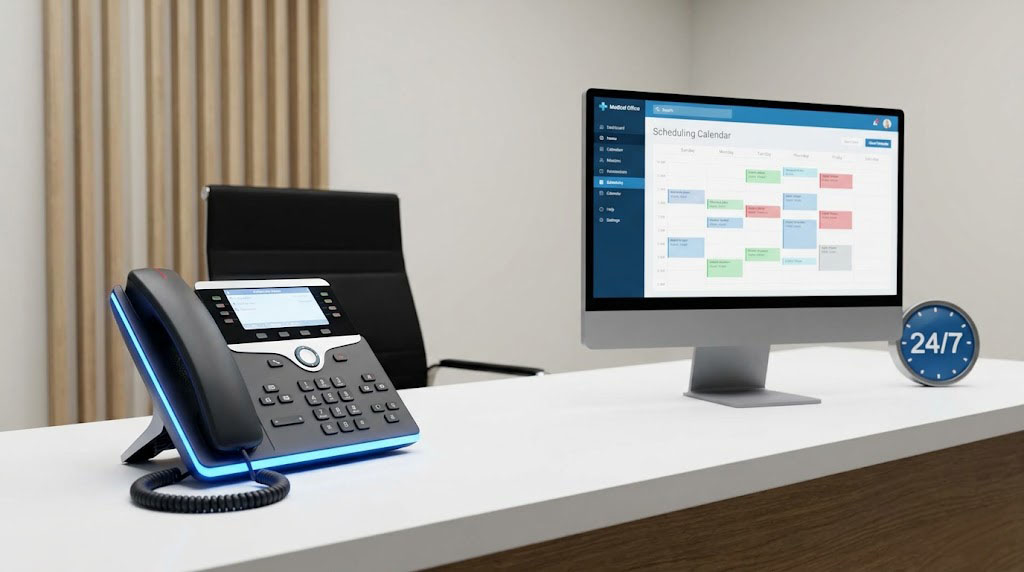
THE MATH BEHIND THE MISSED CALLS
Every Unanswered Ring Is a Patient Who Found Another Door
Most practices losing money on the phone do not lose it because the staff is bad. They lose it because the math does not work. A two-person front desk with a real check-in queue, real walk-ins, real refill questions, and real callbacks is already maxed out before the phones even start ringing on a Monday at ten. Calls go to voicemail. Voicemails get returned Tuesday afternoon, by which point the patient booked with someone else, walked into an urgent care, or stopped trying. A reasonable estimate inside an independent primary care or specialty practice is that fifteen to twenty percent of inbound calls go unanswered or unreturned during a typical week. At a hundred and fifty calls a week, that is twenty-five patients a week who did not get on your schedule. Most of them quietly leave.
The two relief valves practices reach for first are the after-hours answering service and the legacy IVR phone tree. Neither of them solves the problem. The answering service takes a message, emails it in the morning, and the appointment the patient wanted Monday is one they booked elsewhere by Tuesday. The phone tree pushes patients through a menu they did not want to navigate in the first place, and the press-zero traffic still lands on the same overloaded front desk. Hiring a third receptionist is twelve to eighteen months of payroll for a problem that mostly hits a four-hour window every weekday morning and goes quiet at 6 p.m. Practice owners do the math and decide the bleed is cheaper than the fix. The bleed compounds.
GlacePhoneSmart was built to be the fix that pencils out. One voice AI option, bundled with the platform you already use to run the schedule and the billing, that picks up every ring, talks like a competent front-desk person, books a real slot when a real slot exists, hands off to your staff the moment the patient asks for a person, and works the outbound list at the same time. No staff added. No additional vendor to integrate. No subscription line item for a voice agent.
SEVEN CAPABILITIES, ONE PRODUCT
What GlacePhoneSmart Actually Does
Seven capabilities, all running through the same chart, the same scheduler, the same billing layer, and the same hand-off path to your staff. Inbound and outbound, English and Spanish, on the same product.
Virtual receptionist
Answers as your practice, in your practice’s name, in the patient’s preferred language. Identifies the caller from the inbound number when the number is on file. Routes the conversation to the right place in the chart before the patient finishes their first sentence. Hands off to your front desk the moment the patient asks for a person.
AI IVR your patients tolerate
Replaces the legacy phone tree with a conversational menu the patient navigates by speaking, not by pressing keys in sequence. The patient says what they need. The system understands the intent and proceeds. Press zero for a person is always live, on every branch.
Books appointments over the phone
When the system offers a Tuesday at 2:15 with Dr. Patel, that slot is a real slot in the real GlaceEMR scheduler. Provider rules, visit-type templates, and slot durations are honored. The chart entry posts immediately, the front desk sees the new appointment, the patient gets an SMS confirmation. No double-booking, no manual retyping.
Accepts payments over the phone
A patient with a balance can pay during the call. The card capture runs through PCI-DSS compliant infrastructure; the card number never touches your staff, never lands in the EMR, and is tokenized through your payment processor. The payment posts to GlaceRCM the moment it clears, the receipt goes to the patient by SMS or email.
Appointment reminders
Outbound reminder cadence of seven days, three days, and one day before each appointment by default, configurable per practice. SMS-first for the patients who prefer it, voice fallback for the patients who do not confirm. Two-way reschedule on the same thread, so the patient can move the appointment without calling back to a front desk that may not pick up.
Billing reminders and collection calls
Outbound calls and SMS that work patient balances on a tactful cadence. TCPA rules for consent and call windows are observed. Regulation F rules for debt-collection language and frequency are observed. The patient can pay during the call through the PCI-DSS card capture, set up a payment plan, or transfer to a human biller during business hours.
Clinical reminders sourced from the chart
Outbound calls and SMS to patients overdue for mammograms, A1Cs, colonoscopies, annual wellness visits, vaccines, and the other care-gap items your quality program tracks. The reminder list is sourced from the active problem list in the chart, not a CSV your staff uploads weekly. The patient can book on the call, defer with a callback, or transfer to a nurse.
BOOK YOUR DEMO
Hear a Real Call on Your Demo
We will play you a recorded conversation the agent handled live: a patient booking, a balance question, a phone payment, a clinical reminder closing a care gap. Thirty-minute demo, no slide deck if you do not want one.
Prefer the phone? Call (888) 452-2363. We answer on every ring.
HOW IT IS PRICED
Bundled with the Platform. No Separate Voice-AI Contract.
GlacePhoneSmart is one of four bundled options that ride on GlaceEMR and by extension on GlaceRCM. There is no separate subscription line for voice AI. There is no per-minute meter that prices you into surprise invoices at the end of a busy month. There is no implementation-fee surcharge for connecting the voice layer to your scheduler and your billing, because the voice layer was built inside the same platform that runs the scheduler and the billing.
GlaceRCM customers (the ~98% of Glenwood clients who run the full bundle of GlaceEMR software, practice management, and medical billing service on a percentage-of-collections contract with no base fees) get GlacePhoneSmart inside the bundle. The smaller share of customers who self-bill and run GlaceEMR on its own can turn GlacePhoneSmart on as a bundled option on the EMR contract. The pricing model is the platform’s pricing model, full stop. We will walk you through the math on the demo against your call volume and your patient panel size.
THE AI INFRASTRUCTURE UNDERNEATH
HIPAA-Compliant Voice AI, Built on Enterprise Providers
GlacePhoneSmart is built on HIPAA-compliant AI infrastructure from Amazon, Google, Anthropic, Deepgram, ElevenLabs, and other enterprise AI providers. Speech recognition, language understanding, reasoning, and voice synthesis each ride on the provider best suited for that part of the stack, with Business Associate Agreements in place across every layer that touches protected health information.
A multi-vendor architecture preserves operational redundancy and continuous improvement. When a model improves, you inherit the improvement. When a provider has an incident, traffic routes around it. The provider stack is an implementation detail. The thing your practice sees is a voice agent that answers competently in English and Spanish, twenty-four hours a day, on a phone number you already own.
WHAT THE PATIENT EXPERIENCES
The Patient Hears Your Office Name and a Conversation That Already Knows Them
The greeting is short and recognizably your practice. “Thank you for calling Riverside Internal Medicine. This is Glace, a voice assistant for the practice. This call may be recorded, and you can press zero or say agent at any time to reach a person. How can I help?” The patient says what they need. No menu number, no key press, no waiting on hold for the system to introduce itself for ninety seconds.
When the inbound number matches a patient on the panel, the conversation is identified from the first turn. The system knows which patient is on the line, which appointments are scheduled, which balance is open, which refills are pending, which care-gap items are overdue. The patient does not spell their name, repeat their date of birth, or read insurance numbers to a system that already has all of it on file. The conversation begins where it would have begun if a front-desk person who knew the patient had picked up.
Spanish-speaking patients hear the greeting in Spanish when the chart’s preference is Spanish or when the patient says “Spanish” or “español” in the first turn. The full conversation runs in Spanish: booking, balance, payment, clinical reminders, hand-off to a Spanish-speaking staff member when one is reachable. The translation is native bilingual, not an English script read out in Spanish. Every inbound call generates a transcript pinned to the chart capturing the words spoken, the actions taken, and the time stamps. Your front-desk lead can review the audio and override any action the system took. The voice agent is not a black box.
The disclosure is honest from the first sentence. Patients are told they have reached a voice assistant for the practice, that the call may be recorded, and that a person is one word away on every turn. Practices that worry about patient pushback on AI on the phone usually discover the opposite is true: the patients who have spent five years pressing one for English, two for billing, three for appointments, four to speak to a representative, and then waiting twelve minutes on hold are visibly relieved when the conversation starts with someone (or something) that actually listens. The honesty up front is what makes the rest of the call easy.
EVENINGS, WEEKENDS, HOLIDAYS
24/7 Phone Coverage Without Hiring a Night Shift
Patients call at 9 p.m. about a fever. At 6:30 a.m. about a refill before they leave for work. On Saturday morning about a balance they want to clear before the weekend ends. On Christmas Eve about whether the holiday hours posted on your website are right. Every one of those calls is a patient experience moment. Most practices send those calls to voicemail or to an answering service that takes a message your team reads three hours later. GlacePhoneSmart picks up.
The after-hours conversation is calibrated to the time of day. Routine calls (booking, rescheduling, billing, refill questions, hours and directions) are handled by the agent on the call. Clinically urgent calls are escalated through your existing on-call pager tree the same way they would have been escalated by your answering service, with the transcript and context handed to the covering provider so the patient does not repeat themselves. Routine voicemails simply do not happen, because the routine work was finished on the first ring.
For your team, the Monday-morning workload changes. The voicemail box is not full. The pink-slip stack is not waiting. The patients who needed to book over the weekend already booked. The patients who needed to pay already paid. Your staff arrives to a queue that has been worked overnight, and the four-hour Monday-morning phone rush no longer hits the front desk because most of those callers reached the practice on Sunday and got what they needed.
WHAT THE FIRST SIXTY DAYS LOOK LIKE
The Operator Math, From Week One to the End of Month Two
Week one is the configuration week. The voice agent is provisioned against your practice’s number (or a forwarded number you control), the chart’s patient panel is connected, the scheduler is connected, the billing layer is connected, the on-call escalation tree is mirrored from the workflow your answering service already uses, and the practice’s greeting is recorded in the voice and language you want. The configuration is collaborative, not a black-box deployment. Your front-desk lead and your biller are in the room. The recording you sign off on at the end of the week is the recording your patients hear on Monday morning.
Weeks two through four are the supervised-overflow phase. The agent picks up calls only when the front desk has been on the phone for more than a configured number of seconds, or only after a configured number of rings. Every call the agent handles produces a transcript your team reviews the next morning. The reviews surface the edge cases that need calibration: a question your practice answers a particular way, a referral workflow that needs a different routing, a specialty-specific intake form the patient should be sent. Calibration is small and continuous. The agent does not change the world overnight, and that is the point.
By the end of week six the front-desk picture has changed. The voicemail box is no longer the queue. The agent answers every ring during the Monday-morning rush and every ring during lunch and every ring after 5 p.m. Routine bookings, balance lookups, refill triage, and rescheduling have moved off the front desk’s plate, and the front desk has time to do the higher-judgment work that only a person can do: handling the upset patient face-to-face, working the prior-auth callback, calling the specialist’s office to chase down a record. Most practices we onboard report a measurable change in the patient experience in the same window: shorter holds (because there are no holds), fewer voicemails returned the next day (because the call was finished on the first ring), and a noticeable bump in same-week bookings driven by patients who would previously have stopped trying when nobody picked up.
By the end of month two the outbound side is producing measurable revenue effects. The appointment reminder cadence has reduced no-shows in the visit types you configured it for. The billing reminder cadence has accelerated patient-responsibility collections, with a meaningful share of the recovery happening through payment-on-the-call. The clinical reminders have started closing care-gap items the practice had been carrying for months: the mammograms booked, the colonoscopies referred, the diabetic patients back on the schedule for the A1C they were due for. The work the voice agent does is not flashy. It is the work that compounds.
PRACTICES ON THE PLATFORM
What Physicians Running GlaceEMR and GlaceRCM Say
“Peace of mind. Comprehensive, easy to use. I would highly recommend Glenwood.”
Aura Ardon, MD
Florida
“Revenue has increased substantially. Claims go out immediately.”
Naga Prasuna Madireddy, MD
Ohio
“Customer service is amazing. Above and beyond, even after hours or on weekends.”
Nikesh Batra, MD
Ohio
QUESTIONS PRACTICE OWNERS ASK FIRST
Frequently Asked Questions
Will my patients know they are talking to AI?
Yes. The greeting discloses that the caller has reached a voice assistant for the practice and that the call may be recorded. We do not impersonate a human, and we do not hide the AI. The patients we see most often complete the conversation with the agent are the ones who would have hung up on a phone tree. The patient who wants a person says so, presses zero, or asks for an agent, and the call transfers on the first ring during open hours or routes through your on-call escalation tree after hours.
Can it book appointments without double-booking my schedule?
The agent books against the real GlaceEMR scheduler in real time. The slots it offers exist in the scheduler at the moment the offer is made. Provider availability rules, visit-type templates, and slot durations are honored. If your front desk is on another call booking the same slot, the second booking is prevented and the patient is offered the next available slot in the same conversation. The chart entry posts immediately, the front desk sees the new appointment, and the patient gets an SMS confirmation.
How do payments over the phone stay PCI-compliant?
Card capture runs through PCI-DSS compliant infrastructure end to end. The card number never touches your staff, never lands in the EMR, never appears on a printed page, and never appears in the call transcript stored against the chart. Tokenization happens on the payment processor’s side; the platform receives the token, posts the payment to GlaceRCM, and the receipt goes to the patient by SMS or email. The compliance footprint of phone payments shrinks from “the entire front desk” to “the payment processor.”
What about Spanish-speaking patients?
Spanish is a first-class language across every capability. The greeting fires in Spanish when the chart preference is Spanish or when the patient says “Spanish” or “español” in the first turn. Booking, balance lookups, payments, appointment reminders, billing reminders, and clinical reminders all run natively in Spanish. The hand-off path routes to a Spanish-speaking staff member when one is reachable; when one is not, the agent completes the conversation in Spanish and the transcript is on the chart for your team to follow up.
What is the pricing model?
GlacePhoneSmart is bundled inside GlaceEMR and GlaceRCM. There is no separate voice-AI subscription line, no per-minute meter, and no implementation fee for connecting the voice layer to your scheduler and billing (the voice layer is the platform). GlaceRCM customers get it inside the percentage-of-collections contract with no base fees. Customers who self-bill and run GlaceEMR on its own turn GlacePhoneSmart on as a bundled option on the EMR contract. We will walk you through the math against your call volume and panel size on the demo.
What happens if the patient has a clinical emergency after hours?
The after-hours escalation path runs through your existing on-call pager tree, exactly the way a clinically urgent call to your answering service would have escalated. The agent recognizes urgency cues, asks the screening questions your practice configures, and routes the call to the covering provider with the transcript handed over. Press zero, “agent,” and “human” remain live on every branch, at every hour. Always a person is reachable.
See What Glenwood Can Do for Your Practice
A 20-minute working call. We show you the platform on your specialty’s actual workflows, not a generic demo.