
GLACERCM | LANDING
Your Billing Company Gives Up After 90 Days. We Don’t.
GlaceRCM is the Glenwood revenue cycle bundle: GlaceEMR software, the Practice Management System your charges flow into, and the medical billing team that works every claim to resolution. Priced as a percentage of collections. No base fees, no setup charges, no implementation invoice, no contract you can’t leave. 95%+ first-pass claim adjudication. 99%+ collection rate of payer-allowed amounts.* Thirty years building the platform. Twenty-five years running the billing service.
*Of payer-allowed amounts.
30+
Years Since 1994
95%+
First-Pass Claim Adjudication
99%+
Collection Rate of Payer-Allowed
$0
Setup, Implementation, Switch
WHY YOU’RE READING THIS PAGE
The Money Is in the Claims That Got Tired of Being Worked
If you clicked an ad about lost revenue or about a billing company that walked away, you already know the pattern. The headline number on your monthly statement is not the number your contracts entitle you to. The gap is real, it is recurring, and it is fixable. Most independent practices lose that gap to four predictable failures, every one of which compounds month over month while the office manager keeps signing the same percentage check.
Denied claims get written off at 90 days. The first denial gets an appeal. The second gets a half-hearted resubmission. The third gets a status change to “uncollectible” and disappears from the worklist, because the billing contract pays for activity, not for resolution. The biller who would have to spend forty minutes on a peer-to-peer call to clear the medical-necessity denial has no economic reason to do it. The denial closes. The revenue you earned stays unpaid. You never see the line item it came from because the aging report stops showing claims after they are written off.
The named relationship turned into a ticket queue. The regional billing company you signed with five years ago got acquired. The owner you knew retired. The two billers who knew your payers, your providers, and your patient mix have left or been reassigned. Your account is now in an offshore pool, routed by ticket category, and the person who answers the phone has read your account for the first time three minutes before the call started. The institutional memory that made the original relationship work was the entire value, and it walked out the door with the people who carried it.
There is no transparency on what is actually being worked. You get a monthly cash number and a percentage invoice. You do not get a denial-by-category report, a payer-by-payer aging breakdown, an underpayment recovery line, or a credentialing-status summary. When you ask, the answer takes two weeks to arrive and arrives in a format that does not reconcile to anything else you have. You cannot tell whether the cash you collected was the right number, whether the gap was the payer’s fault or the biller’s fault, or whether next month’s number is going to be better or worse. You are running a business on a single aggregate figure that nobody will defend in detail.
The renewal raised the percentage and nobody negotiated it. The contract auto-renewed at a higher rate. The fine print added a per-statement fee, a per-call fee, or a credentialing fee that did not exist when you signed. The cost of switching looked higher than the cost of accepting the raise, so you accepted the raise. Two years later the cumulative drag is meaningful and you are reading this page because the gap finally got loud enough to do something about.
FOUR THINGS THAT CHANGE WHEN YOU SWITCH TO GLACERCM
What’s Actually Different
We built the billing model around one principle: our revenue is your revenue. Nothing we charge is decoupled from what lands in your account. The four pillars below are the operating consequences of that pricing decision.
Percentage of collections, no base fees
One number. A percentage of what we collect for you. No base monthly minimum, no per-claim fee, no per-statement fee, no clearinghouse pass-through, no implementation invoice, no setup charge, no early-termination penalty. If we do not collect the dollar, we do not earn on the dollar. That alignment is the whole model.
The percentage itself is set during the free revenue assessment and depends on specialty, payer mix, and monthly charge volume. It is one rate, written into one contract, with no schedule of accessory fees buried underneath it. The monthly invoice you sign is the monthly invoice you can read in two minutes.
Every claim worked to resolution, not parked at 90 days
Every denial is worked. Not 80% of them. Not the ones above a dollar threshold. Every one. The team appeals at the level the payer’s policy specifies, escalates to peer-to-peer or to the medical director when the clinical case supports it, and closes the loop with the chart documentation the appeal needs without a chart dive your physician has to interrupt clinic for.
Underpayment recovery runs as a parallel workstream. Every paid line is compared to the contracted fee schedule for that payer, that plan, that procedure, and that modifier combination, and the variance gets appealed with the contract documentation already attached. Aging is not a category of claim we write off. It is a category of claim we keep working.
AI denial prediction at submission
GlaceIQ, the AI substrate woven through the platform, scores every claim’s denial probability against the payer’s adjudication patterns before submission. High-risk claims get flagged inside the worklist so the biller can correct the documentation, coding, or modifier before the claim leaves the building. The biller reviews the suggestion and decides; the AI does not submit anything on its own.
When a denial does come back, the AI categorizes it by root cause (eligibility, coding, documentation, authorization, timely filing, medical necessity, coordination of benefits, bundling) and routes it to the workqueue the team can act on fastest, with the suggested appeal language attached. The team works ten denials in the time the typical clearinghouse-plus-biller arrangement works three.
A named account lead. Not a ticket queue.
Your account lead is named on the contract, introduced on day one, and stays with the account. The lead answers the phone when you call, owns the relationship inside Glenwood, escalates internally when an issue needs more weight, and runs the monthly business review with your owner or office manager.
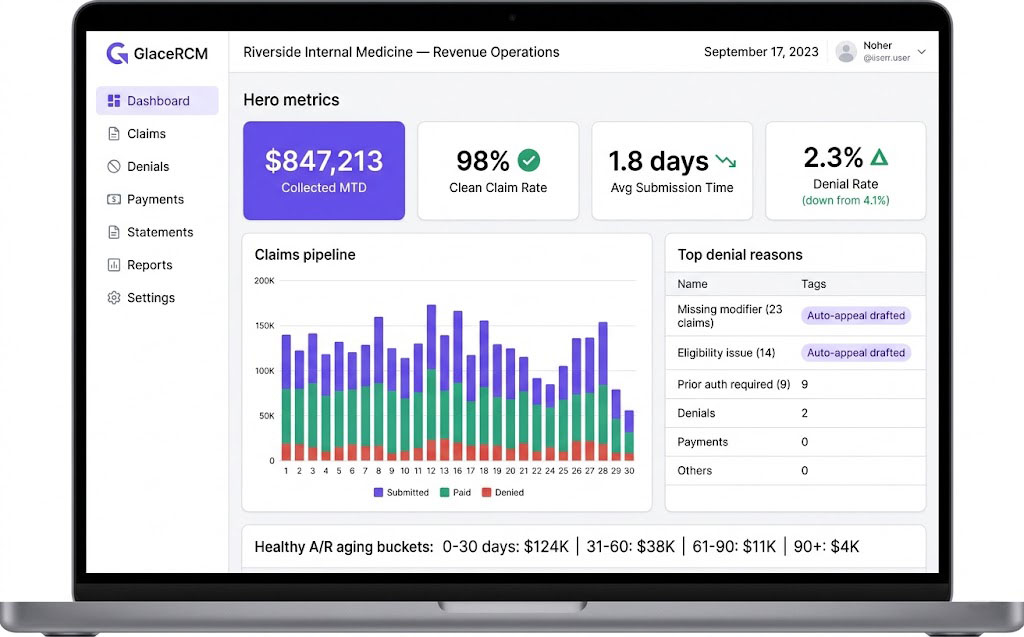
Cash collected. Claims submitted. Denials by category. A/R aging. Payer mix. Productivity by provider. The monthly review is on the calendar, not on demand, and the same numbers show up every month so the trend lines do the talking. The institutional memory of how your practice runs lives with one person who has carried it from go-live forward.
FREE | NO PRESSURE
Get a Free Revenue Assessment
A thirty-minute working call with a Glenwood revenue-cycle lead. We read your aging report, look at your denial pattern by payer, and tell you what we think you are leaving on the table and what it would take to recover it. No obligation. No pressure. If the math does not work for your practice, you keep the assessment and we part friends.
Or call us directly at (888) 452-2363. No setup fees. No implementation charges. No contract you can’t leave.
THE PRICING MODEL, IN DETAIL
Why a Percentage of Collections Aligns Our Incentives With Yours
The pricing model is the whole product strategy. Everything operational that happens downstream of the contract (the daily worklist, the denial cadence, the appeal escalation, the underpayment recovery, the patient-collections follow-through) is shaped by whether the people running the work get paid for activity or for collection. We chose collection. The model has held since 1998, and the operational behaviors that fall out of it are the reason the 95%+ first-pass and 99%+ collection numbers are reachable instead of aspirational.
One number, set against your book. The percentage is set during the free revenue assessment after we read your aging report, your denial pattern by payer, and the specialty-and-payer-mix profile that defines the work. A behavioral-health practice with a commercial-heavy panel does not get quoted the same rate as a high-volume primary-care practice with a Medicare-dominant panel, because the cost-to-collect profile is different and the rate that fits one would be unfair to the other. The number we quote is the number on the contract, and the number on the contract is the only number on the invoice.
Nothing decoupled. Nothing accessory. Per-claim fees create an incentive to submit volume. Per-statement fees create an incentive to send statements that may not convert. Per-call fees create an incentive to log activity that may not resolve. Implementation invoices create a one-time revenue event that the billing company can collect on regardless of whether you ever generate a clean month. Every one of those accessory charges decouples the biller’s revenue from your revenue, and the operational behavior follows the money. We do not charge any of them. Setup is zero. Implementation is zero. Termination is zero. The percentage is the model.
What this means at the worklist level. The biller working your account is rewarded for working the difficult denial, not for closing it as uncollectible at day 90. The team is rewarded for chasing the underpayment against the contracted fee schedule, not for posting the payer’s number and moving on. The account lead is rewarded for finding the patient-balance population that will actually pay if outreach is sequenced right, not for sending a statement that returns undeliverable. None of these behaviors requires a memo. The contract does the work, because the contract is the percentage.
What this means at renewal. There is no renewal raise. The contract does not auto-escalate. There is no minimum-term lock, no liquidated-damages clause, and no early-termination penalty. The 98% client concentration on GlaceRCM is a renewal outcome that practices choose every month they stay, not a contract trap that holds them in. If the math stops working for your practice, we want to know about it before you leave, not after. The free revenue assessment is the same conversation we would have with a current client whose monthly review surfaced a number that needs a decision.
WHAT YOU’RE BUYING WHEN YOU BUY GLACERCM
Three Legs, One Contract, One Account Team
GlaceRCM is one purchase with three parts. The software your providers chart in. The PMS your charges, eligibility, claims, and patient accounts live in. And the medical billing team that works your account inside the PMS your physicians document into. The same company designed the chart, designed the PMS, and runs the billing service. About 98% of Glenwood clients run on the full GlaceRCM bundle, because the chart-to-claim integration depth is what makes the 95%+ first-pass and 99%+ collection numbers reachable.
LEG 1
GlaceEMR software
The ONC-certified EHR your physicians document in. Twenty-plus specialty modules, sixty-plus two-way lab interfaces, fifteen-plus hospital interfaces, native PACS and DICOM, native telehealth, native iOS and Android apps, and 30+ AI features inside the workflow. Inside GlaceRCM the EMR is included at no extra cost. The chart that captures the charge cleanly is the chart the billing team can collect on cleanly.
LEG 2
Practice Management System
The PMS where eligibility, charges, claims, ERAs, posting, patient accounts, statements, and payment plans live. Designed alongside the EMR, not bolted to it: the chart and the claim share a data model, so the charge that signs in the chart at 4:42 PM is in the submission queue at 4:42 PM. GlaceBillSmart, the AI billing automation, lives inside this PMS as a built-in capability of the bundle.
LEG 3
Medical Billing Service
The human team that works your account daily. Claim submission and posting. Denial appeals worked to resolution, not closed at day 90. Underpayment detection at the line item. Payer follow-up on aging A/R. Patient statement runs and payment plans. Credentialing and re-credentialing. The team operates as an extension of your front office under one named account lead. Twenty-five years running this service since 1998.
SWITCHING FROM YOUR CURRENT BILLING ARRANGEMENT
From Signed Contract to First Clean Month
Switching billing companies sounds risky because the failure case is cash falling off a cliff during the handoff. The Glenwood onboarding playbook is built around not letting that happen. Five defined stages, parallel billing through the cutover, and a named account lead who owns the transition end to end.
STEP 1
Free revenue assessment
A thirty-minute working call with our revenue-cycle lead. You share an aging report and a recent denial export. We read both, surface what we think you are leaving on the table, and quote the percentage that fits your specialty, payer mix, and charge volume. No obligation. The assessment is yours to keep.
STEP 2
Contract and account team
One contract, one percentage, no schedule of accessory fees. Your named account lead is introduced inside the first week, payer credentialing transfer is initiated, and your data extracts from the previous system are scoped. Provider, payer, fee schedule, patient account, and historical encounter data all get mapped before the cutover line is drawn.
STEP 3
Parallel billing window
Thirty to sixty days of parallel run. Your previous biller works the legacy A/R. Our team works the new claims inside the new PMS. The legacy A/R cleanup runs as a parallel workstream so historical claims do not orphan. The window is sized to your volume and complexity, not to a generic project plan.
STEP 4
Cutover
The cutover line is moved forward as the legacy book finishes. The new submission stream is live in the new PMS. ERAs auto-post into the encounter the claim was generated from. Your front desk runs eligibility in the new system, your providers chart in the new EHR, and the named account lead is on standby for the first two weeks.
STEP 5
First full month, then monthly business review
First clean month closes. Cash collected, claims submitted, denials by category, A/R aging, payer mix, and provider productivity all show up in the monthly business review with your owner or office manager. The agenda is the same numbers every month so the trend lines do the talking. The decisions that come out of the meeting are tracked, owned, and revisited.
PRACTICES WHO SWITCHED
In Their Own Words
“Peace of mind. Comprehensive, easy to use. I would highly recommend Glenwood.”
Aura Ardon, MD
Florida
“Revenue has increased substantially. Claims go out immediately.”
Naga Prasuna Madireddy, MD
Ohio
“Customer service is amazing. Above and beyond, even after hours or on weekends.”
Nikesh Batra, MD
Ohio
QUESTIONS PRACTICE OWNERS ASK BEFORE THEY SWITCH
Frequently Asked Questions
What percentage do you charge?
One percentage of collections, set during the free revenue assessment based on your specialty, payer mix, and monthly charge volume. No base fees, no per-claim fees, no per-statement fees, no implementation invoice, no setup charge, no clearinghouse pass-through. The exact percentage is part of the conversation because the right number for a behavioral-health practice with a high commercial mix is not the right number for a high-volume primary-care practice with a Medicare-dominant mix. We do not publish a number that would be misleading for half the practices that ask. The assessment gives you a specific rate against your specific book, and you decide from there.
Is there a contract? Can I leave?
There is a contract that lays out the percentage, the scope, the named account team, and the service commitments on both sides. There is no early-termination penalty, no minimum-term lock, and no liquidated-damages clause. If GlaceRCM does not work for your practice, you give standard notice and we work the transition out as professionally as we worked the onboarding in. The 98% client-base concentration on GlaceRCM is a renewal outcome, not a contract trap. Clients stay because the math works, and if it stops working we want to know about it before you leave, not after.
What’s actually included in GlaceRCM?
One contract, one percentage, three legs. Leg one: GlaceEMR software, the ONC-certified EHR your physicians document in, included at no extra cost. Leg two: the Practice Management System where eligibility, charges, claims, ERAs, posting, patient accounts, and statements live, including GlaceBillSmart, the AI billing automation, as a built-in capability. Leg three: the medical billing team that works your account inside the PMS, with claim submission, denial appeals, underpayment recovery, payer follow-up, patient statements, payment plans, and credentialing. One named account lead. One monthly invoice. The optional GlacePhoneSmart voice-AI layer (virtual receptionist, IVR, reminders, over-phone payment) is available as an add-on for practices that want it.
How long does it take to switch from my current billing arrangement?
RCM onboarding runs four to eight weeks from signed contract to first clean month, depending on the size of the legacy book, the credentialing transitions involved, and the data-migration scope. The window includes a parallel-run period of 30 to 60 days in which your previous biller works the legacy A/R while our team works the new claims inside the new PMS. The cutover line moves forward as the legacy book finishes. The point is to never let cash fall off a cliff during the handoff, and to give your office staff a real safety net while the new arrangement proves itself.
What happens to my existing A/R?
The legacy A/R is handled in one of two ways and you choose during the assessment. Path one, your previous biller continues to work the legacy book during the parallel-run window and we take the new submission stream cleanly; this is the most common pattern because it minimizes risk on the historical book. Path two, our team takes over the legacy A/R as part of the cutover and works it inside the new PMS; this is the right path when the previous biller is non-cooperative, the rollup absorbed them entirely, or the relationship has already broken down. Either way, no legacy claim is allowed to orphan, and the credentialing transitions are sequenced so the cash stream remains continuous.
Do I have to switch EMRs?
For the full GlaceRCM bundle, yes. The 95%+ first-pass and 99%+ collection numbers are downstream of the chart-to-claim integration the bundle is built on, and we do not run the billing service on third-party EHRs. About 98% of Glenwood clients run on the full bundle for that reason. If you want to keep your current EHR, the right product for that conversation is GlaceEMR software-only (the standalone path for the 2% of clients who self-bill), which is a different relationship and a different page. The free revenue assessment will tell you honestly which path fits your practice; if the math does not work for the switch, we will say so.
See What Glenwood Can Do for Your Practice
A 20-minute working call. We show you the platform on your specialty’s actual workflows, not a generic demo.