

Medical training equips physicians to excel in patient care. Yet the business side of healthcare often receives far less attention, despite its direct influence on financial sustainability.
Revenue cycle management (RCM) is typically viewed as a behind-the-scenes administrative process. In reality, it plays a far greater role. From the moment a patient enters your practice to final reimbursement, every stage of the revenue cycle affects operational efficiency, financial performance, and the patient experience.
Understanding how clinical decisions, documentation habits, and workflow patterns influence the revenue cycle strengthens practice performance.
Join us to explore the fundamentals of healthcare revenue cycle management and its strategic role in driving operational success.
What Is Revenue Cycle Management?
A patient’s journey typically begins the moment they walk into a healthcare facility and continues through diagnosis, treatment, and care delivery. For medical practices, the journey doesn’t end there. The process concludes when the physician receives full reimbursement for their services.
Revenue cycle management in healthcare is the process of managing the entire financial process associated with patient care, from scheduling an appointment to collecting the final payment.
This may sound straightforward. A patient books an appointment, receives the necessary care, and the practice gets paid. But in reality, the process is more intricate than it appears.
Behind every patient encounter lies a series of administrative and financial steps shaped by payer contract requirements, prior authorizations, compliance regulations, and evolving reimbursement policies. Even minor errors can result in claim denials, leading to cash flow challenges and revenue leaks.
The 2026 Kodiak Solutions benchmark report states that healthcare organizations lost $48.4 billion in revenue due to the combined impact of denials, bad debt, and uncollected patient balances.
Effective revenue cycle management streamlines each stage of your revenue cycle, improving efficiency and boosting revenue capture.
The Healthcare Revenue Cycle Management Workflow
Healthcare organizations vary widely in size and structure, from small private practices with only a handful of physicians to large health systems comprising hundreds of providers. Consequently, revenue cycle operations also vary by staffing, technology capabilities, and available resources.
Nevertheless, the healthcare revenue cycle generally follows the same foundational structure across most organizations and is typically divided into three key phases:
- Front-End Revenue Cycle
- Mid-Cycle Revenue Management
- Back-End Revenue Cycle
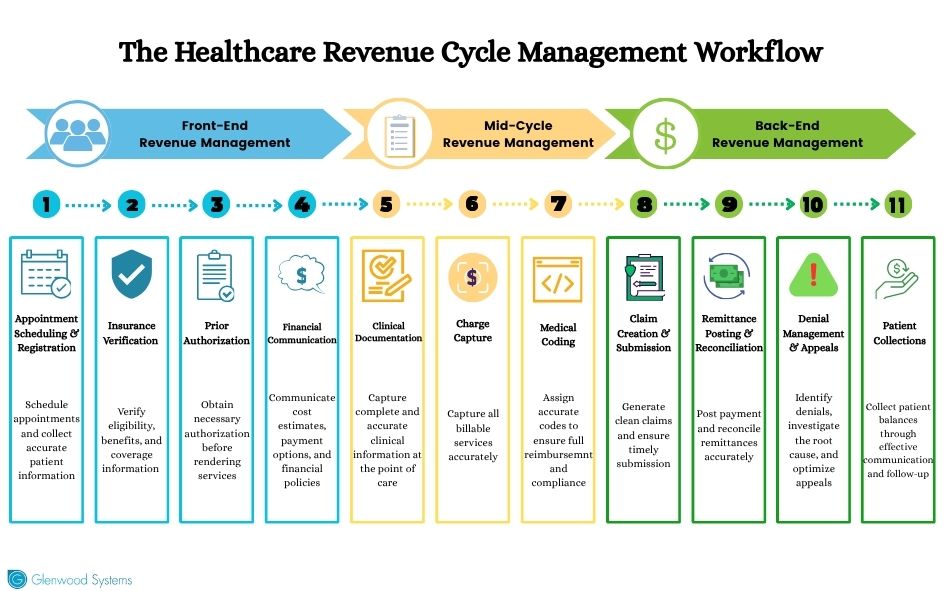
Let’s discuss each phase in detail.
Front-End Revenue Cycle
The revenue cycle begins the moment a patient interacts with your practice at the front desk or on a digital platform. Although it’s an administrative task, the front-end revenue cycle is as critical as care delivery. The accuracy of information collected at this stage directly affects claim quality, reimbursement timelines, and the overall patient financial experience.
The front-end revenue cycle includes:
1. Appointment Scheduling and Registration
The first step in the revenue cycle is scheduling an appointment . Today, patients may book appointments by phone, on a website, or through a patient portal. Easy self-scheduling options, an intuitive digital experience, and timely assistance create a positive first impression and enhances the patient experience and retention.
Once the appointment is scheduled, the patient registration process begins. At this stage, the front-end staff collect essential information, including:
- Patient demographics
- Insurance and coverage details
- Referral information
- Relevant medical history
- Contact information
Claim quality depends on accuracy. Even seemingly minor errors during registration, such as incorrect policy numbers, dates of birth, or misspelled names, can lead to claim rejections, reimbursement delays, and administrative rework.
2. Insurance Verification
Real-time insurance verification confirms the plan’s status, covered services, and the patient’s responsibility. It’s also essential for identifying secondary coverage and ensuring the appropriate payer workflows are followed, including coordination-of-benefits rules and authorization requirements.
3. Prior Authorization
Certain procedures, diagnostic tests, medications, and specialty services require prior authorization from insurance payers. At this stage, the front-end team identifies authorization requirements and secures the necessary approvals to ensure services are eligible for reimbursement.
Missing prior authorization is the second most common cause of claim denials. AI-driven automation streamlines prior authorization workflows through real-time verification and faster approvals, reducing delays, patient out-of-pocket costs, and write-offs.
4. Financial Communication
Financial communication involves discussing patient responsibilities before providing services. It includes:
- Explaining co-pays, deductibles, and coinsurance
- Sharing cost estimates
- Discussing coverage limitations
- Offering payment plans or financial assistance options
With nearly 44% of American adults struggling to afford healthcare costs, upfront financial communication has become imperative. Transparent and proactive financial discussions help patients prepare for out-of-pocket expenses while reducing the likelihood of unpaid balances or bad debt.
Mid-Cycle Revenue Management
The mid-cycle phase of the revenue cycle focuses on translating clinical care into billable claims. Once treatment is provided, the physician and care team document the services delivered, and that information flows through three critical activities:
5. Clinical documentation
After the patient encounter, the physician records the care and services delivered. Clinical documentation must accurately capture the patient’s condition, severity, comorbidities, medical decision-making, and all services rendered. It should clearly justify the medical necessity and ensure compliance with payer and regulatory requirements.
For example, consider a 72-year-old patient with a history of diabetes and hypertension presenting with chest pain and shortness of breath. The physician’s documentation should include details on symptom onset and nature, associated risk factors, physical examination findings, diagnostic tests ordered (such as an ECG and troponin levels), and the clinical decision to admit the patient for possible acute coronary syndrome.
Documentation accuracy is vital; it influences every downstream revenue cycle process, including coding integrity, reimbursement outcomes, claim quality, and audit compliance.
6. Charge capture
Physician documentation is followed by charge capture, which involves recording every billable service, including professional services, procedures, diagnostic tests, and medical supplies, and transferring those details into the billing system for claim generation and reimbursement.
Charge capture errors, especially missed or incomplete charges, often represent unrecoverable reimbursement opportunities that directly impact net revenue.
7. Coding
Physician documentation contains detailed information about the care and services provided during a patient encounter. However, payers must first translate that information into standardized medical codes for payers to process the claim.
Medical coding involves converting clinical documentation into universally recognized ICD-10-CM diagnosis codes and CPT/HCPCS procedure codes, along with the appropriate modifiers when required. When clinical documentation is unclear, incomplete, or contains conflicting information, coders may issue a physician query, a formal request asking the provider for clarification or additional information so the claim can be coded accurately and compliantly.
The challenge is to stay current with changing coding regulations and varying payer requirements. Coding errors, such as mismatched codes, upcoding, undercoding, or incorrect modifier usage, frequently cause claim denials, underpayments, delayed reimbursements, compliance concerns, and increased audit risk.
Automated coding software and AI-assisted coding tools minimize manual workload, improve coding accuracy, identify documentation gaps, and reduce the likelihood of human error, ultimately supporting cleaner claims and more efficient reimbursement workflows.
Back-End Revenue Cycle
The back-end phase of the revenue cycle focuses on securing accurate reimbursement and recovering full practice revenue. This stage is critical for maintaining cash flow, resolving payment issues, and minimizing revenue leakage.
Key components of the back-end revenue cycle include:
8. Claim creation and submission
Once documentation, coding, and charge capture are completed, the information is compiled into a medical claim and passed through a process known as claim scrubbing. Automated claim scrubbing software reviews claims for errors, inconsistencies, or missing information that could lead to claim rejections or denials.
For example, if a procedure code requires a modifier to indicate bilateral treatment and the modifier is missing, the claim scrubber flags the issue before a claim is submitted.
Claims containing errors are routed back to the appropriate team for review and correction. Once claims are scrubbed and validated, they are electronically submitted through clearinghouses, which act as intermediaries between healthcare organizations and insurance payers. The clearinghouse performs additional checks before forwarding the claims to the payer for adjudication.
9. Remittance posting and reconciliation
After the payer processes each claim, healthcare practices receive reimbursements along with documents such as the Electronic Remittance Advice (ERA) and Explanation of Benefits (EOB). These documents explain how the claim was adjudicated and the portion of the payment that was approved, adjusted, or denied.
Next comes payment posting, where the billing team accurately records insurer payments, contractual adjustments, patient co-pays, deductibles, and any remaining outstanding balances within the billing system.
The team then reconciles posted amounts against the expected (contracted) allowed amount to identify underpayments, payment discrepancies, denied claims, or unpaid balances that require follow-up. For example, if a payer reimburses less than the contracted rate for a procedure, the billing team must investigate the discrepancy and, if necessary, initiate an appeal process.
10. Denial management and appeals
An efficient revenue cycle management process focuses on two key goals: preventing denials whenever possible and resolving denied claims quickly and effectively when they occur.
Because denials remain one of the largest sources of revenue leakage in healthcare, denial management and appeals are critical to maintaining financial stability.
Nevertheless, AI and automation are transforming the denial management workflow by accelerating denial resolution, reducing workload, and boosting revenue recovery. Advanced AI-powered RCM platforms like GlaceRCM support:
- Intelligent denial triage
- Automated, timely appeal workflow
- Predictive identification of high-risk claims
- Proactive detection of billing and coding errors
11. Patient collections
Patient financial responsibility not collected upfront is typically billed after payment reconciliation with the payer. Even when initial payments are collected at the time of service, patients may still have outstanding balances for co-pays, coinsurance, uncovered services, or payer adjustments, which are recovered at this stage.
As enrollment in high-deductible health plans continues to rise, patient collections have become an increasingly important component of practice revenue. This shift has also made patient collections more challenging. Practices can improve collection efficiency and reduce outstanding balances through:
- Upfront cost estimates
- Digital payment options
- Automated payment reminders
- Flexible payment plans
Simplifying Revenue Cycle Complexity with Glenwood Systems
Revenue cycle management is far from simple. Evolving payer guidelines, staffing shortages, and rising administrative demands make it even harder. Traditional manual workflows are inefficient, delay reimbursements, and cause revenue leaks.
The smarter approach is to adopt intelligent, technology-driven RCM solutions. Glenwood Systems’ advanced AI-powered revenue cycle management tools help you manage these challenges more efficiently. With automated eligibility verification, ambient AI documentation, intelligent denial management, and streamlined claims processing, our solutions reduce the operational burden and improve overall revenue performance.
Redirect your focus to patient outcomes. We’ll streamline the revenue cycle behind the scenes.