
HOSPICE
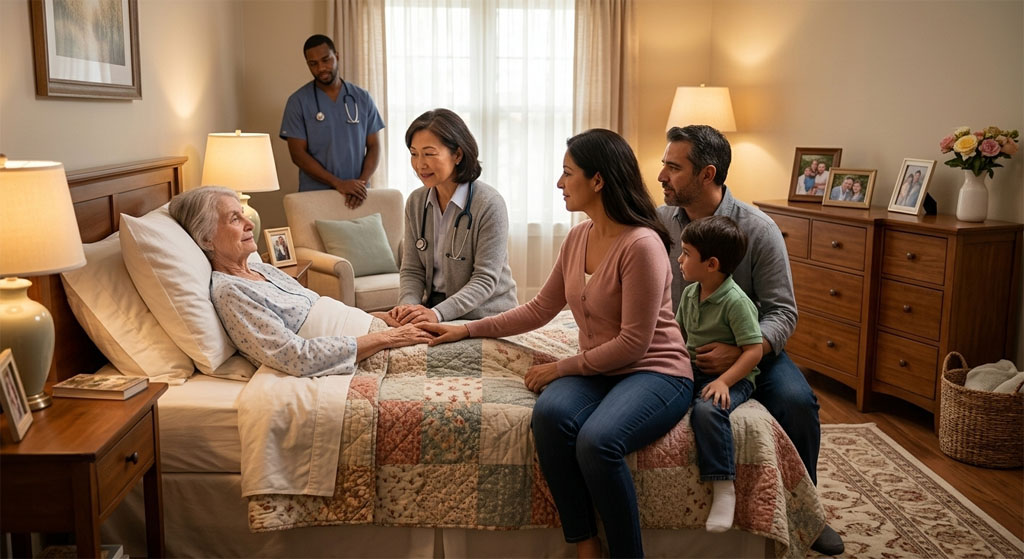
Run Your Hospice Around the IDG, the Benefit, and the Family
One interdisciplinary plan of care across home, facility, and inpatient settings, per-diem revenue by level of care, and certifications and the cap tracked so the program is never exposed. That is the work GlaceEMR and GlaceRCM are built around, at a percentage of collections with 95%+/99%+ results*.
*Of payer-allowed amounts.
WHAT WE HEAR FROM HOSPICE MEDICAL DIRECTORS
Hospice Is a Different Kind of Medicine
Care is delivered by an interdisciplinary team against one living plan, billed per diem by level of care, governed by certification and face-to-face requirements, and extended thirteen months past the patient’s death through bereavement. None of that fits an ambulatory EMR, and most legacy platforms have no concept of a level-of-care per-diem or an IDG cadence. Four pains come up in the first thirty minutes of every discovery call.
The team documents in five places
An RN, a social worker, a chaplain, an aide, and a volunteer coordinator each chart in whatever module is closest. The patient is one person; the chart should be one chart. When it is not, the IDG meeting becomes a forensic exercise instead of a clinical one.
Recertifications and face-to-face slip
A benefit period closes and the face-to-face attestation due by day 30 is still on a task list. One missed face-to-face on a long-stay patient produces a takeback that wipes out a month of margin, learned about from a corrective action plan.
The hospice cap is a year-end surprise
Long-stay patients accumulate and the aggregate cap builds toward a liability nobody watches in real time. The cap report runs once a quarter, the number is reassuring, and then the year ends and the MAC bill arrives.
The 13-month bereavement runs on paper
The benefit funds bereavement for thirteen months after death, but most platforms drop the family from the census the moment the patient dies. The follow-up cadence lives in a spiral notebook, and the surveyor’s request becomes a deficiency.
GLACEEMR FOR HOSPICE
An EHR Built Around the Interdisciplinary Team and the Benefit
GlaceEMR is ONC-certified, with 30+ years of company history behind it, and runs in the same configuration across every setting your program touches: home, ALF, SNF, and inpatient unit. The hospice configuration is wired in before training starts. The interdisciplinary plan of care, the level-of-care engine, the comfort-kit eMAR, the benefit-period and face-to-face tracker, and the 13-month bereavement program are all in the platform on day one.
One interdisciplinary plan of care
Physician, RN, social worker, chaplain, aide, and volunteer coordinator all chart into one living plan across physical, emotional, spiritual, and psychosocial domains. The IDG meeting reconciles a single document, and the cadence the benefit requires is tracked so a missed meeting is visible before it becomes a deficiency.
Level-of-care engine tied to billing
Routine home care, continuous home care, general inpatient, and respite live in one engine. A level-of-care change updates the orders, the documentation requirements, the place-of-service, and the per-diem revenue code in a single action, with the supporting documentation already in the chart.
Certification and face-to-face tracker
Benefit-period certification and recertification dates, terminal prognosis attestation, and the face-to-face encounter at the third benefit period live in one dashboard. Items due in 14, 7, and 2 days surface on the medical director’s worklist, and a face-to-face is not allowed to slip past day 30 without an alert that names the patient.
Symptom management and the comfort kit
Structured workflows for pain with opioid titration, dyspnea, nausea, agitation, terminal delirium, and secretions. Comfort-kit ordering is one click. ESAS and PAINAD scores trend on the chart, and an escalating symptom trajectory triggers a worklist task before the family is calling the on-call line at 2 AM.
Multi-setting workflow and visit scheduling
The same chart follows the patient from home to ALF to SNF to inpatient unit; the place of service and per-diem update and the orders adapt. A visit calendar coordinates a distributed team across the service area, captures mileage at each visit, and shows the clinical manager the full day of visits on one screen.
13-month bereavement and the 5% volunteer rule
A bereavement module carries the family through the thirteen months the benefit funds: risk assessment, the 30, 90, 180, and 365-day cadence, counselor visits, and the closing letter all live in the record. The 5% direct-care volunteer requirement tracks continuously, so the coordinator opens one report instead of building it the night before survey.
Included with GlaceEMR vs usually an add-on
When you price out a hospice platform, count what is included before you compare the headline number. The rows below are a separate bereavement module, a separate app, a separate scheduler, or a separate administration suite almost everywhere else. They ship with GlaceEMR, with no tier games and no surprise line items.
| Capability | Most hospice software | GlaceEMR |
|---|---|---|
| IDG plan of care and meeting documentation | Add-on module | Included |
| 13-month bereavement and family-support module | Separate subscription | Included |
| Pharmacy and comfort-kit eMAR integration | Interface fee | Included |
| Native iOS and Android apps for the field team, offline | Mobile-web only | Included |
| GlaceOffice administration suite (HR, PTO, credentials) | Separate subscription | Included, free for clients |
| Multi-site, multi-program, role-based access | Per-site upcharge | Included |
A structured medication review reconciles the active regimen against the comfort goals of care, so the regimen that arrives at the home shrinks to what serves comfort. Controlled-substance accountability across distributed home settings, DME coordination from the chart, and surveyor-ready HOPE and CAHPS reporting all run inside one record, on single-tenant hosting with LUKS encryption at rest. Grow from a single program to a multi-site hospice across several counties without renegotiating the contract.
FROM ADMISSION TO PAID
One Institutional Path, Tracked End to End
The team admits the patient and certifies the benefit period, the IDG reconciles one plan on the cadence the benefit requires, the NOE files inside the window, and your billing team works the 837I per-diem claim to resolution. One record and one team carry the per-diem from the home visit to the deposit, with the documentation that defends a GIP or CHC day already attached, so nothing falls through a handoff between vendors.
GLACERCM FOR HOSPICE
A Billing Service That Runs Institutional Hospice Claims for a Living
GlaceRCM bills your claims in your EMR or ours, at a percentage of collections with no base fees. We would rather run it on our platform, where the scrubber sees the full chart, but if you are staying on your system our team works your claims there. The service is built for the institutional 837I, the per-diem-by-level-of-care model, the NOE and NOTR notices, the GIP and continuous-care documentation, and the hospice cap.
95%+
First-pass claim adjudication. Most 837I institutional claims pay on the first submission, with no rework and no exposure on the NOE timely-filing window.
99%+
Collection rate of payer-allowed amounts*. The per-diem dollars the benefit owes you actually arrive, because we work the institutional queue to resolution.
$0
Implementation fee, setup charge, and monthly minimum. We get paid when you get paid, so our interests and yours line up from the day the contract is signed.
*Of payer-allowed amounts.
Per-diem billing tuned to the four levels of care
Each level carries a different revenue code, per-diem, documentation requirement, and proration when the level changes mid-day. The scrubber knows the rules per MAC and per payer, and the claim carries the right revenue code on the right calendar day with the documentation already attached.
NOE and NOTR filed inside the window
The Notice of Election and Notice of Termination or Revocation file inside the timely-filing window, with room-and-board lines for facility-based hospice handled on the same claim. The exposure that comes from a late NOE does not open.
The cap calculated continuously
The aggregate cap is calculated continuously, not once a quarter on a spreadsheet. Where the program stands by month, by cohort, and by patient is on the administrator’s dashboard the same day a long-stay patient moves the number, so decisions get made with the cap visible in July.
A named billing specialist
A dedicated account manager who knows institutional hospice claims, GIP and CHC documentation, and your MAC. Not a ticket queue, not an offshore call center. They know your program by name within a month of go-live, and a write-off happens only when you sign off.
Percentage of collections, no base fees. Credentialing, NOE and NOTR submission, cap reconciliation, denial follow-up on a GIP or CHC day, and the call center your families use are part of the service, not separate line items. If your current biller is running below 95%+ first-pass on the 837I, what we charge tends to pay for itself out of the per-diem dollars you start collecting that were quietly written off before.
AI AND FAMILY ENGAGEMENT
The Documentation, the Cap, and the Phones
Every AI capability is a suggestion your clinician reviews and selects. Notes wait for a signature and codes wait for approval before either reaches a claim. The AI is built on HIPAA-compliant infrastructure from Amazon, Google, Anthropic, Deepgram, ElevenLabs, and other enterprise AI providers, with multi-vendor architecture that preserves operational redundancy and keeps the platform improving over time.
GlaceScribe
Ambient documentation for the field visit and the IDG meeting. Up to four speakers, which matters in a home where the patient, an adult child, the aide, and the RN may all be in the room. English and Spanish patient-facing. The IDG note exits as a structured document that satisfies the conditions of participation.
GlaceIQ
30+ AI features tuned to the program: recertification and face-to-face surveillance, symptom-trajectory pattern detection, a forward cap projection from the active census, and ICD-10 suggestions paired with the terminal diagnosis. Your team reviews and selects each one.
GlacePhoneSmart
An AI phone agent answers as your program in English or Spanish, takes referral and family calls, routes urgent calls to the on-call nurse, and surfaces voicemail summaries, so the on-call burden on your clinical managers drops and a family reaching the program at 10 PM still gets the answer they need.
A family-facing portal, mobile app, SMS, and email round out the stack, with English and Spanish on every family-facing surface and bilingual caregiver handouts tied to the plan of care. Visit confirmations, bereavement check-ins, and secure messages route back into the record as structured tasks instead of into an inbox somebody reads on Monday, so the care your program delivers after death is documented as carefully as the care it delivers before.
SWITCHING IS EASIER THAN YOU THINK
Coming From Another Hospice Platform
Most hospice programs we onboard are leaving a legacy EMR, a horizontal product bolted onto a hospice module, or a niche product that never updated for HOPE and the cap. The transition is the part you dread most, and the part we have done hundreds of times on programs where care is delivered every single day. Implementation is $0, data migration is included, and your account manager runs the move and stays your account manager after go-live.
DAY 1
A chart that already looks like yours
You log in to migrated patient history, active certifications, interdisciplinary plans of care, current comfort-kit and symptom regimens, and recent visit notes, with your IDG templates, symptom protocols, level-of-care order sets, and bereavement intake forms already wired in. EMR go-live happens in under one week. The first visits run slower because the workflow is new; by the end of the day the team’s hands start to remember where everything lives.
DAY 30
Documenting faster, claims flowing
Your field team documents visits faster on the mobile app because the templates match how they chart, and GlaceScribe runs on most visits so the IDG note no longer eats a clinical manager’s afternoon. Your first month of NOEs is in the MAC window, your first 837I claims are submitted, and your first per-diems are posting. The cap dashboard is live and the recertification worklist is current.
DAY 90
The switch starts paying for itself
Your first quarter’s dashboard shows cleaner institutional claims, faster posting, fewer denials parked in the 60-to-90 bucket, NOEs filed inside the window, and GIP and CHC days defended on first submission. The cap forecast is in front of the administrator every week, GlacePhoneSmart has visibly cut the on-call call burden, and the team’s documentation finishes when the visit finishes. The conversation turns from migration triage to optimization.
Data migration covers historical patient records, certifications, the active plan of care, current medications and the comfort kits in homes, allergies, outstanding orders, and the active census across all four levels of care, handled by Glenwood from your prior vendor’s export in 2 to 5 business days, so your team does not clean charts. The RCM transition runs 4 to 8 weeks with MAC enrollment in parallel, and we recommend a 30-to-90-day overlap with your previous vendor while the new chart proves itself. Training is delivered in pieces around real visit schedules, not a block that suspends admissions. Glenwood has been independent and privately held since 1994, when our founder helped his physician wife acquire a private practice in Connecticut: 30+ years in market, no outside investors. Support runs 7:00 AM to 8:00 PM Eastern on weekdays, with 24×7 on-call coverage for urgent issues, because a hospice program is delivering visits at midnight and the system needs to be reachable.
WE KNOW YOUR CLAIM
We Have Billed Your Mix Before
You already know your claim. We have built the workflows, the scrubber rules, the documentation prompts, and the denial templates around it, so the per-diem you earned is the per-diem you collect. The list below is the short version of what runs every day inside the platform for a hospice program:
- 0651: Routine Home Care per diem (RHC)
- 0652: Continuous Home Care per diem (CHC)
- 0655: Inpatient Respite Care per diem (IRC)
- 0656: General Inpatient per diem (GIP)
- 0657: Hospice Physician Services
- Z51.5: Encounter for palliative care, paired with the principal terminal diagnosis
- GW / GV modifiers: Attending-physician visits unrelated / related to the terminal condition
- 837I: Institutional claim format, with NOE and NOTR notices filed inside the timely-filing window
QUESTIONS WE HEAR EVERY WEEK
Hospice Program FAQ
Short answers below; the longer conversation happens on the demo. Tap any question to expand the answer.
Does GlaceEMR handle all four levels of care natively, with per-diem billing in the same record?
Yes. Routine home care, continuous home care, general inpatient, and respite are all carried in one level-of-care engine. A level change updates the clinical orders, the documentation requirements, the place-of-service code, and the per-diem revenue code on the institutional claim in a single action. The clinical reality and the unit of payment move together, in the same chart, with the supporting documentation already in place to defend the GIP or CHC day at audit. The 0651, 0652, 0655, and 0656 revenue codes drop on the right calendar day with the right minute thresholds and clinical rationale already attached. Programs that move to us from platforms without this integration tell us the GIP and CHC revenue line items climb in the first quarter purely because the documentation defending those days is finally consistent.
How does GlaceEMR keep recertifications and the third-period face-to-face from slipping?
Benefit-period certifications, the face-to-face encounter at the third benefit period, and the 14-day IDG meeting cadence are all tracked in one surveillance dashboard. Items coming due in 14, 7, and 2 days surface on the medical director’s and clinical manager’s worklists. The 30-day face-to-face attestation window on the third benefit period is not allowed to close without an alert that names the patient and the clinician owed the visit. The recertification packet, including the prognosis narrative, is assembled from the chart for the physician to review and sign. A program-wide surveillance view shows the administrator everything coming due in the next 30 days at a glance, instead of running a spreadsheet from a clinical manager’s notebook the night before the IDG.
Is GlaceScribe HIPAA-compliant, and how does it handle hospice family meetings and IDG?
Yes, fully HIPAA-compliant. GlaceScribe runs on HIPAA-compliant AI infrastructure from Amazon, Google, Anthropic, Deepgram, ElevenLabs, and other enterprise AI providers, all under business associate agreements. The multi-vendor architecture preserves operational redundancy, so a single upstream incident does not stop the team’s visits. Up to four simultaneous speakers are supported, which matters in a hospice home where the patient, an adult child, the home-health aide, and the RN may all be in the room at once. English and Spanish patient-facing. The IDG meeting can be captured: each patient’s review pulls forward the interval data, the symptom trajectory, and the level-of-care reasoning, and the meeting note exits as a structured document that satisfies the conditions of participation. All coding and order suggestions surface for clinician review before signing; nothing reaches the chart until the clinician approves it. Audio is processed in transit, the note is stored in your single-tenant chart database with LUKS encryption at rest, and data never trains a shared model.
How does GlaceRCM handle the hospice cap and prevent year-end surprises?
The aggregate cap is calculated continuously, not once a quarter on a spreadsheet. Where the program stands against the cap by month, by admission cohort, and by patient is on the administrator’s dashboard the same day a long-stay patient triggers movement on the number. GlaceIQ also projects forward the program’s cap position for the rest of the cap year based on the active census, the level-of-care mix, and patient-specific length-of-stay trends. Admission decisions, level-of-care decisions, and discharge decisions get made with the cap visible in July, not in January when the MAC takeback notice arrives. Programs we onboard tell us this is the single dashboard the administrator opens first every Monday morning.
What does GlaceRCM pricing look like, and can we keep our EMR?
You pay a percentage of what we collect, with no base fees, no implementation charges, no setup fees, and no monthly minimums. The exact percentage depends on your census, your level-of-care mix, your payer panel (traditional Medicare, MA, Medicaid hospice, commercial), and your volume, and you will have it after a 20-minute discovery call. We would rather run the full bundle, where the billing quality depends on a tight integration with the chart, and about 98% of Glenwood clients choose that path. But we are flexible: if you want to keep your current EMR, our billing team will work your claims in your EMR or ours. You will not see surprise line items for credentialing, NOE and NOTR submission, cap reconciliation, denial follow-up on a GIP or CHC day, or the call center your families use, because all of that is part of the service. The 95%+ first-pass adjudication and 99%+ collection rate of payer-allowed amounts are how we operate across our active institutional client base.
“[Specialty-specific testimonial quote, replace with verified Hospice medical-director or administrator quote or remove this card.]”
[Medical Director or Physician Name, MD]
[State]
If your organization runs adjacent programs, see how GlaceEMR runs home health, skilled nursing, long-term care, and geriatrics.
See What Glenwood Can Do for Your Practice
A 20-minute working call. We show you the platform on your specialty’s actual workflows, not a generic demo.