

Owning a private practice is the ultimate return to clinical autonomy. It gives you the freedom to make decisions, build lasting patient relationships, and deliver care as you envisioned.
However, leaving a steady paycheck to start your own practice can feel intimidating. With careful planning, sound financial management, and strong operational leadership, you can position yourself for a successful launch and sustainable growth.
In this blog, we’ll cover key steps to help you get started. Let’s begin with the most important question.
Is Private Practice Right for You?
Running a private practice can feel like the ultimate career goal. But are you prepared for the financial, operational, and administrative responsibilities that come with it?
Ask yourself these practical questions:
- Are you prepared to make critical financial and administrative decisions independently?
- Can you balance patient care with 5–10 additional hours of business management each week?
- Can you navigate fluctuating income during your practice’s early growth phase?
If the freedom to shape your clinical approach and control your schedule outweighs the stability of employment in medicine, you’re ready for the next step.
Validate Your Business Idea
An established reputation at a hospital or health system doesn’t automatically translate into a full schedule. Before investing startup capital, validate your market and define your clinical niche.
Take time to understand the following factors:
- Market demand: Assess population health trends and local access to care. Evaluate whether your community genuinely needs your services. Indicators such as long appointment wait times, care access gaps, or limited specialty services often signal opportunities for a new practice.
- Competitor analysis: Analyze the provider landscape in your target ZIP codes. Assess provider density, services offered, and appointment availability to identify care gaps and unmet patient needs.
- Population demographics: Understand the characteristics of your target population, including age distribution, family composition, and the prevalence of chronic conditions. Resources such as the U.S. Census Bureau’s American Community Survey (ACS) can provide valuable insights into the communities you plan to serve.
- Local payer mix: Understand the percentage of patients covered by Medicare, Medicaid, commercial insurance, employer-sponsored plans, and self-pay. Your local payer mix affects reimbursement potential, credentialing priorities, and revenue projections.
Create a Financial Roadmap
Launching a private practice requires a realistic financial plan. Startup costs vary by specialty and practice model, ranging from under $50,000 for a lean, virtual-first practice to 500,000+ for a traditional clinic.
Before opening your doors, develop a budget that covers both one-time startup expenses and ongoing operating costs.
Typical startup expenses include:
- Office lease and build-out
- Medical equipment and supplies
- Furniture
- Electronic health record (EHR) and practice management software
- Licensing, legal, and registration fees
- Malpractice and business insurance
- Initial marketing
- Technology and cybersecurity
Plan for a 6-12 month ramp-up. Maintaining sufficient working capital to cover at least six months of personal expenses and three months of operating costs helps you weather reimbursement delays and focus on growing your practice.
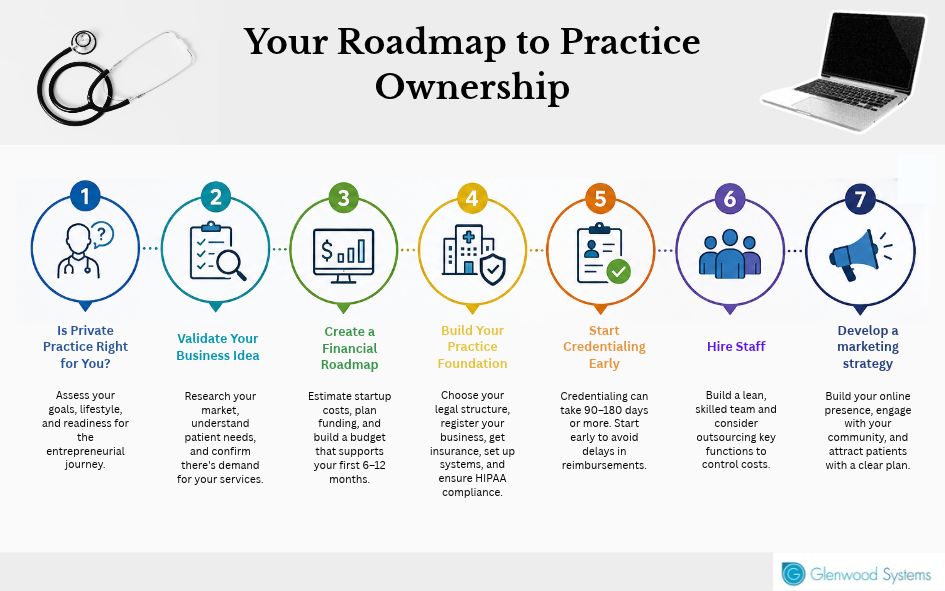
Build Your Practice Foundation
Once you’ve developed your financial plan, it’s time to establish the legal and operational framework for your practice.
Key steps include:
- Register your business: Choose the appropriate legal entity (such as a sole proprietorship, PLLC, or LLC) and formally file it with your state registration board.
- Establish your business finances: Obtain an Employer Identification Number (EIN) from the IRS to open a dedicated business bank account.
- Secure insurance: Obtain malpractice, general liability, and cyber insurance to protect your practice.
- Develop HIPAA-compliant policies: Establish robust internal privacy and security policies to safeguard patient information and ensure compliance.
- Select the right technology partner: Choose scalable EHR and practice management platforms with integrated AI to streamline operations.
Start Credentialing Early
Payer credentialing typically takes 90–180 days, or longer. If you plan to accept Medicare or commercial insurance, start credentialing early to avoid reimbursement delays or cash flow issues.
Hire Staff
Instead of hiring aggressively, build a lean team that grows with your practice. Start with versatile staff who can handle front-desk operations and basic clinical responsibilities.
Leveraging technology helps you maximize efficiency. Solutions such as GlacePhoneSmart for patient communication and GlaceRCM for revenue cycle management automate routine administrative tasks, improve efficiency, and optimize productivity.
Outsourcing RCM, credentialing, payroll, IT, and marketing lowers overhead and the administrative burden while providing access to experienced specialists.
Develop a Marketing Strategy
Opening your doors doesn’t guarantee patients will walk in. Traditional word-of-mouth still matters, but today patients find, vet, and choose their doctors online. Building a predictable patient panel requires a strong digital presence and a marketing framework that turns online visibility into trust.
Here’s how:
- Build a professional, mobile-friendly website.
- Create and optimize your Google Business Profile.
- Build referral relationships with local physicians and healthcare organizations.
- Connect with your target audience on social platforms
The Support You Need to Grow
Launching a private practice isn’t about making every decision right from day one. Thoughtful planning helps you avoid costly mistakes, adapt to challenges, and build a practice that thrives for years.
At Glenwood Systems, we help turn your vision into reality. Whether it’s practice management or revenue cycle management, our solutions take the administrative burden off your plate.
Already happy with your practice management setup but need help with billing? Or prefer to keep billing in-house and need support with practice management? You choose the level of support you need, and we deliver.
Have a vision for your practice? Let’s bring it to life.