
DERMATOLOGY
Run Your Dermatology Practice Around the Body Map, the Biopsy Loop, and the Procedure Day
A 38-patient procedure day with a dozen biopsies, three excisions, two cryos, a Mohs referral, and four biologic re-auths runs cleanly when the chart is built around the lesion, the photo, and the path loop. Every specimen tracks to its result, every modifier lands, and every cosmetic visit is split from the medical one before the patient leaves. That is your day on GlaceEMR and GlaceRCM, at a percentage of collections with no base fees, backed by 95%+ first-pass claim adjudication and 99%+ collection of payer-allowed amounts*.
*Of payer-allowed amounts.
WHAT WE HEAR FROM DERMATOLOGISTS
Visual, Procedural, and High-Throughput
Dermatology is visual, procedural, and high-throughput, and most platforms were built for a single acute visit, not for a full-body skin exam, a biopsy-to-path loop that has to close, and a procedure day that runs 35 patients deep. Four pains come up in the first thirty minutes of almost every discovery call, and each one quietly costs you time, revenue, or both.
The skin exam dies as free text
A lesion needs to be locatable, photographed, measured, and compared visit-to-visit. The 2 mm pigmented lesion you flagged last June has no pin, no photo, and no surveillance interval, so when it returns at 4 mm you are reconstructing the visit from memory.
Pathology does not auto-link
Attaching the path result to the right specimen and body site is manual. A wrong link is a serious clinical risk, and the abnormal melanoma result hides inside a stack of benign nevi reports while the surveillance interval never gets set.
Procedure modifiers leak revenue
When the platform does not prompt by technique, lesion count, and size, the 11102 with an 11103 add-on gets billed as a single 11102, the 17000 with three 17003 add-ons goes out as one, and the -25 that justifies the same-day E/M is forgotten.
Biologics and iPLEDGE are side jobs
Biologic re-auths every 6 to 12 months and the iPLEDGE monthly cadence live in a spreadsheet and a paper binder. The auth lapses, the pharmacy denies the fill, and the flare lands on your urgent schedule before anyone realized the paperwork was overdue.
GLACEEMR FOR DERMATOLOGY
An EHR Built Around the Image and the Lesion
GlaceEMR is ONC-certified and has run in dermatology practices for years, with 30+ years of company history behind it. The dermatology configuration is wired in before training starts, so the chart your team opens on day one already holds the body map, the biopsy tracker, the procedure templates, the iPLEDGE workflow, and the cosmetic-versus-medical split. Every capability below ships in the platform today, not as a roadmap promise.
Anatomic body map with photo capture
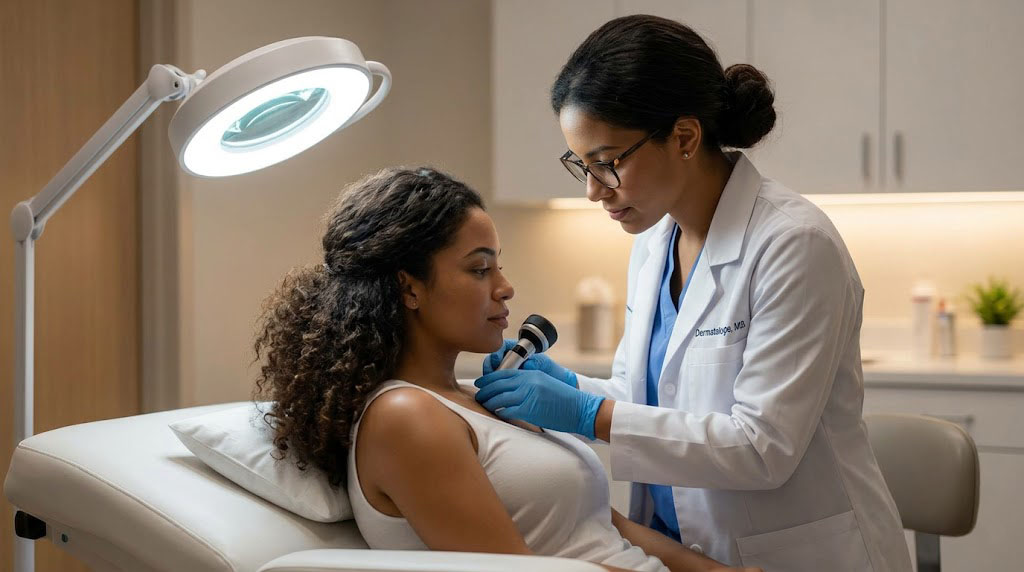
Drop a pin on the body diagram, capture a photo with dimensions and dermoscopy, and the lesion becomes a tracked object with dated photo comparisons across every visit. The 2 mm pigmented lesion is the same pin every time, with every photo stacked, so growth or stability is visible at a glance.
Biopsy-to-pathology tracker
Every specimen is followed from procedure to result to action, with the abnormal pathology flagged and the surveillance interval set the moment the result lands. The shave, the punch, and the excisional each carry specimen numbers that link the path report back to the right pin, so the melanoma result never sits unactioned.
60+ dermpath and lab interfaces
Quest, Labcorp, BioReference, your dermatopathology labs, and more than 50 hospital and reference labs are connected today for the biologic safety panels (CBC, CMP, hepatitis serologies, QuantiFERON TB) and patch-test workups. Results flow back with multi-year trending and land attached to the ordering lesion or problem.
Procedure templates as discrete data
Punch, shave, and excisional biopsy, excision, cryotherapy, ED&C, intralesional injection, and PDT templates capture site, technique, specimen number, agent, dose, lesion count, lesion size, and closure as discrete fields the claim uses. The note finishes as the procedure finishes, and the codes match the work.
Cosmetic and medical, split cleanly
A visit can carry a medical encounter, a cosmetic encounter, or both, with separate notes, consents, charges, and financial flows, plus a single combined check-out. The chemical-peel patient who points at a temple lesion gets the biopsy on the medical ledger and the peel on the cosmetic ledger, in one chart, on one sign-out.
iPLEDGE and biologic management
Isotretinoin is structured around iPLEDGE: the monthly visit cadence, pregnancy-test windows, counseling acknowledgments, cumulative-dose tracker, and lab monitoring. Biologic workflows carry PASI and DLQI scores, the dosing log, and the safety lab calendar, so the script does not go out until the requirements line up.
Included with GlaceEMR vs usually an add-on
When you price out another EMR for a dermatology practice, count what is included before you compare the headline number. The rows below are upsells or separate vendors almost everywhere else, each with its own renewal date and price increase. They ship with GlaceEMR, with no tier games and no surprise line items.
| Capability | Most EMRs | GlaceEMR |
|---|---|---|
| Native imaging: body map, dated photo comparison, dermoscopy | Separate image-library vendor | Included |
| Teledermatology HD video and store-and-forward | Add-on subscription | Included |
| Care Gap and Population Registry surveillance views | Consulting or ticket | Included |
| Self-check-in kiosk with cosmetic consents, English and Spanish | Third-party vendor | Included |
| GlaceOffice administration suite (HR, PTO, cosmetic inventory) | Separate subscription | Included, free for clients |
| Native iOS and Android apps for providers and staff | Mobile-web only | Included |
A solo practice can grow to 20 providers across locations on the same platform, with no per-location upcharge and no contract to renegotiate when you add a satellite or bring on a Mohs surgeon.
THE BIOPSY LOOP, CLOSED
Every Specimen Tracked to Its Result
The pin you drop on the body map carries a specimen number, the path report links back to that exact lesion, the abnormal result flags for action, and the surveillance interval is set the moment the result lands. The same chart carries the lesion from the exam room to the deposit, so the wrong-lesion mismatch risk is eliminated by design and the high-risk patient comes back at six months because the chart told the front desk two months ago.
GLACERCM FOR DERMATOLOGY
A Billing Service That Knows Your Dermatology Mix
GlaceRCM bills your claims in your EMR or ours, at a percentage of collections with no base fees and no monthly minimums. We would rather run it on our platform, where the scrubber sees the full chart, but if you are staying on your EMR our team works your claims there. The service is built for the dermatology mix: procedure-dense, modifier-sensitive, cosmetic and medical running side by side, biologic re-auths on a calendar.
95%+
First-pass claim adjudication. Most claims pay on the first submission, with no rework and no calendar lost to denial follow-up on the procedures you billed yesterday.
99%+
Collection rate of payer-allowed amounts*. The dollars the payer contractually owes you actually arrive, because we work the queue to resolution instead of writing it off at 90 days.
$0
Implementation fee, setup charge, and monthly minimum. We get paid when you get paid, so our interests and yours line up from the day the contract is signed.
*Of payer-allowed amounts.
Lesion-count and modifier scrubbing
Multiple-lesion biopsies, excisions, cryos, destructions, and intralesional injections are scrubbed against payer-specific modifier rules (25, 51, 59, XS, XU) before the claim leaves. The 11102 with its 11103 add-on lands as the right pair, the 17000 carries its 17003 add-ons, and the -25 sits on the office visit when a procedure happened the same day.
Mohs day billing from the record
Stage-by-stage Mohs billing with closure and repair codes is assembled from the operative record, so the claim matches the documented day without a coder rebuilding it. The 17311 with 17312 add-ons for additional stages, the right repair code, and the linkages to the lesion map all land the day of surgery.
Biologic re-auth on the calendar
Initial auths and re-auths for the psoriasis, eczema, and HS biologics are assembled with the clinical history, PASI and DLQI scores, and the step-therapy documentation the PBM asks for, on the calendar before the auth expires. The patient at month 11 has the packet submitted before month 12, so the next fill clears and the flare never lands on your urgent schedule.
Cosmetic cash-pay, kept separate
Cosmetic charges flow through a separate cash-pay path with patient receipts, package management, and gift-certificate handling that does not tangle with the medical AR. The peel patient pays on a cosmetic receipt, the same-visit biopsy bills to insurance, and the two ledgers reconcile cleanly at month-end without anybody unwinding what posted to the wrong bucket.
Percentage of collections, no base fees. Provider credentialing, payer enrollment, prior auth, daily patient statements, and a US-based billing call center are part of the service, not separate line items. Bundled-procedure, cosmetic-coded, and biologic medical-necessity denials are worked to resolution through appeals, second-level reviews, and peer-to-peer, and the write-off only happens when you sign off. Your patients call our team about a balance or a cosmetic package, not your front desk, so the receptionist checking in your 9 AM Mohs is not on a billing call.
AI AND PATIENT ENGAGEMENT
The Documentation, the Coding, and the Phones
Every AI capability is a suggestion you review and select. Notes wait for your signature and codes wait for your approval before either reaches a claim, so the coding judgment and the clinical decision stay with you. The AI is built on HIPAA-compliant infrastructure from Amazon, Google, Anthropic, Deepgram, ElevenLabs, and other enterprise AI providers, with multi-vendor architecture that preserves operational redundancy.
GlaceScribe
Ambient notes that recognize a full-body skin exam, a problem-focused visit, or an in-office procedure and structure the note for the visit type, with a clean biopsy or destruction note. Up to four speakers, in person or teledermatology, English and Spanish patient-facing. Charting finishes between the excisional and the cryotherapy.
GlaceIQ
30+ AI features tuned to your day: melanoma-surveillance prompts, the Lab Interpreter on biologic monitoring panels, the Drug Cost Comparator at prescribing, the Undercoding Detector on lesion counts, denial prediction before submission, and AI-assembled biologic prior-auth packets. You review and select each one.
GlacePhoneSmart
An AI phone agent answers as your practice in English or Spanish, books into real scheduler slots, runs skin-check and biologic-follow-up recall campaigns, fills the cancellations that open on a packed procedure day, and surfaces voicemail summaries so the front desk stops drowning.
A practice-branded portal, mobile app, kiosk, SMS, and email round out the stack, with English and Spanish on every patient-facing surface and a store-and-forward image path for the rash that does not need a chair. The cosmetic patient signs her consent on the kiosk and the skin-check patient finishes intake before she walks in, both without anyone at the front desk lifting a finger. Replies route back into the chart as structured tasks, so the overdue skin check, the biologic monitoring lab, and the pending-path follow-up get worked on the cadence the care plan calls for instead of living on a sticky note.
SWITCHING IS EASIER THAN YOU THINK
Coming From Another EMR
Most dermatology practices we onboard are leaving a horizontal platform that never fit the imaging-and-procedure load. The transition is the part you dread most, and it is the part we have done hundreds of times. Implementation is $0, data migration is included, and your account manager runs the move and stays your account manager after go-live.
DAY 1
A chart that already looks like yours
You log in to migrated history, active problem lists, current meds, prior pathology, lesion photos, and outstanding orders, with your procedure templates, code favorites, iPLEDGE and biologic workflows, and the cosmetic-versus-medical split wired in. EMR go-live happens in under one week. The first few visits run slower; by the end of the day, your hands start to remember where everything lives.
DAY 30
Charting faster, claims flowing
You are charting faster than on the old system because the procedure templates match how you document, and GlaceScribe carries your skin-exam notes. Your first month of submissions is on the dashboard, the lesion-count modifiers are landing, the cosmetic and medical ledgers reconcile, and you have walked the denial queue with your account manager. The surveillance and recall workflows are live, filling tomorrow from the recall list.
DAY 90
The switch starts paying for itself
Your first quarter’s dashboard shows cleaner procedure claims, faster posting, and the lesion-count add-ons and Mohs stages landing every time. The biologic re-auths are pre-built before they expire, GlacePhoneSmart has cut front-desk call volume, and surveillance recall has brought overdue skin-check patients back into cadence. The conversation turns from migration triage to using the platform harder next quarter.
Data migration covers historical records, documents, lesion photos, problem lists, medications, allergies, prior pathology, and outstanding orders, handled by Glenwood from your prior vendor’s data export so your staff does not have to clean charts. The RCM transition runs 4 to 8 weeks with payer enrollment in parallel, and we recommend a 30-to-90-day overlap with your previous vendor so the practice keeps operating normally. Provider training is delivered in pieces around your real schedule, and every role gets unlimited online training during onboarding with continued access for new hires. Glenwood has been independent and privately held since 1994, when our founder helped his physician wife acquire a private practice in Connecticut: 30+ years in market, no outside investors. Support runs 7:00 AM to 8:00 PM Eastern on weekdays, with 24×7 on-call coverage for urgent issues.
WE KNOW YOUR CODES
We Have Billed Your Mix Before
You already know your codes. We have built the workflows, the scrubber rules, the documentation prompts, and the denial templates around them, so the reimbursement you earned is the reimbursement you collect. The list below is the short version of what runs every day inside the platform for a dermatology practice:
- 11102 to 11107: biopsies (tangential, punch, incisional), single and additional lesions
- 17000 / 17003 / 17004 / 17110 / 17111: destruction of premalignant and benign lesions
- 17311 to 17315: Mohs micrographic surgery, stages and add-on tissue blocks
- 11400 to 11446 / 11600 to 11646: excisions, benign and malignant, by site and size
- 12001 to 13160: repairs (simple, intermediate, complex) and adjacent tissue transfer
- 11900 / 11901 / 96405 / 96406: intralesional injections, including chemo intralesional
- 96910 / 96912 / 96913 / 96567 / 96573 / 96574: phototherapy (UVB, PUVA) and photodynamic therapy
- 99203 to 99215: office E/M, with the -25 modifier when a procedure happens the same day
QUESTIONS WE HEAR EVERY WEEK
Dermatology Practice FAQ
Short answers below; the longer conversation happens on the demo. Tap any question to expand the answer.
Does GlaceEMR really hold a full-body lesion map with photo comparison?
Yes. The anatomic body map is the centerpiece of the dermatology configuration, not a bolt-on. You drop a pin on the body diagram, capture a photo with dimensions, and the lesion becomes a tracked object with dated photo comparisons across every subsequent visit. Dermoscopy attachments, lesion-level annotation, and measurement land on the same pin. The full-body skin exam is captured as a structured field, not a paragraph of free text, so the 2 mm pigmented lesion you noted last year shows up next year as the same pin with the prior photo stacked next to today’s photo. Biopsy specimen numbers link path reports back to the right pin, so the wrong-lesion mismatch risk that lives in flat charts is eliminated by design. Care Gap and Population Registry views surface the patients due for surveillance, so the high-risk panel becomes a managed program with recall logic driving the outreach.
How does GlaceRCM handle modifier-25, lesion counts, and the cosmetic-medical split?
The chart and the claim share a structure, so the lesion-count math, the modifier logic, and the cosmetic-medical split land cleanly. The 11102 biopsy with an 11103 add-on for the additional lesion goes out as the right pair. The 17000 destruction carries its 17003 add-ons. The -25 modifier sits on the E/M when a procedure happened the same day. Cosmetic charges flow through a separate cash-pay path with patient receipts, package management, and gift-certificate handling. The chemical-peel patient who points to a temple lesion mid-visit gets the biopsy on the medical ledger and the peel on the cosmetic ledger, in one chart, on one sign-out, without the front desk refunding anybody on Monday. Payer-specific scrub rules and the Undercoding Detector surface the procedures a busy day left behind, and our team works the denial queue to resolution rather than writing it off at 90 days.
Is GlaceScribe HIPAA-compliant, and where does the AI run?
Yes, fully HIPAA-compliant. GlaceScribe runs on HIPAA-compliant AI infrastructure from Amazon, Google, Anthropic, Deepgram, ElevenLabs, and other enterprise AI providers, all under business associate agreements. The multi-vendor architecture preserves operational redundancy, so a single upstream incident does not stop your visits. Up to four simultaneous speakers are supported, English and Spanish patient-facing, and all coding and order suggestions surface for your review before any signing. Nothing reaches the chart until you approve it, and nothing carries your signature until you sign it. Audio is processed in transit, the resulting note is stored in your single-tenant chart database with LUKS full-disk encryption at rest, and the data never trains a shared model that mixes your patients with anybody else’s.
How does the biologic prior-auth workflow actually work?
For the psoriasis, eczema, and HS biologics, GlaceIQ assembles the documentation packet from the chart: the diagnosis, the PASI or DLQI severity scores at the right cadence, the prior topical and systemic agents that failed for step therapy, the safety labs, and the photos where they help. Initial auths and re-auths land on the calendar before the auth expires, so the patient on a biologic at month 11 has the re-auth packet pre-built and submitted before month 12, the next pharmacy fill clears, and the flare never lands on your urgent schedule. The billing team finishes, validates, and submits, so the 45-minute manual prior-auth project shrinks to a five-minute review and the patient gets the medication their condition actually needs. The whole loop is structured, so somebody calling out sick on a Friday does not put the re-auth at risk.
What does GlaceRCM pricing look like, and can we keep our EMR?
You pay a percentage of what we collect, with no base fees, no implementation charges, and no monthly minimums. The exact percentage depends on your code mix (the medical and cosmetic split, Mohs volume, biologic load), your payer panel, and your volume, and you will have it after a 20-minute discovery call. We would rather run the full bundle, where the billing quality depends on a tight integration with the chart, and about 98% of Glenwood clients choose that path. But we are flexible: if you want to keep your current EMR, our billing team will work your claims in your EMR or ours. You will not see surprise line items for credentialing, denial follow-up, prior auth, statements, or the call center your patients use. The 95%+ first-pass adjudication and 99%+ collection rate of payer-allowed amounts are how we operate across our active client base.
“[Specialty-specific testimonial quote, replace with verified Dermatology physician quote or remove this card.]”
[Physician Name, MD]
[State]
If you carry adjacent panels, see how GlaceEMR runs rheumatology, allergy, oncology, and podiatry.
See What Glenwood Can Do for Your Practice
A 20-minute working call. We show you the platform on your specialty’s actual workflows, not a generic demo.