
PODIATRY
Run Your Podiatry Practice Around the Diabetic Foot, the Coverage Rule, and the Procedure
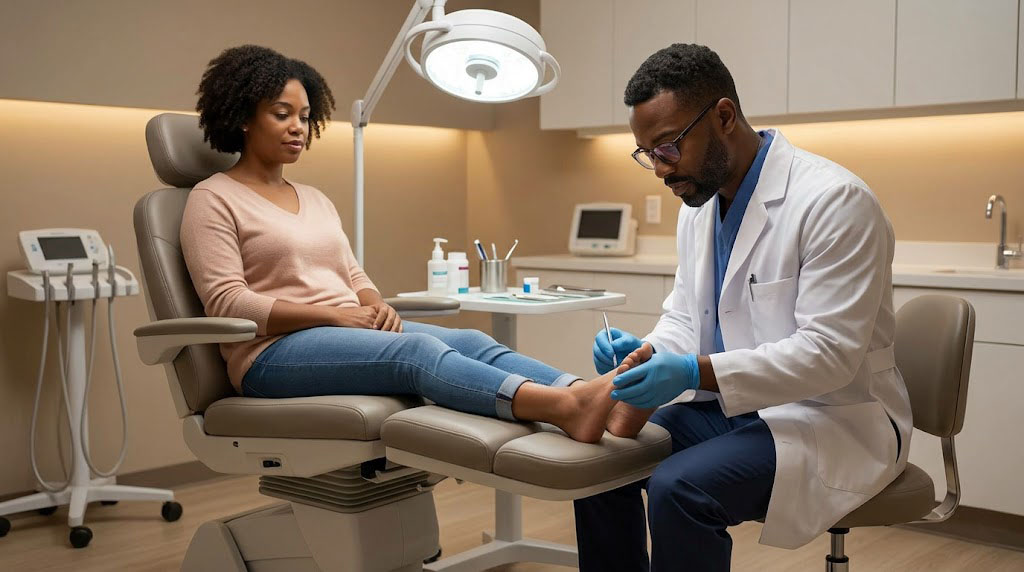
A diabetic with neuropathy, a healing plantar ulcer, and four nails due for debridement arrives at 9:40. Twenty minutes later the wound is measured and photographed, the at-risk class is documented for the Q-modifier, the debridement is captured by depth, and the diabetic-shoe necessity letter is signed. That is your day on GlaceEMR and GlaceRCM, billed at a percentage of collections with no base fees, backed by 95%+ first-pass adjudication and 99%+ collection of payer-allowed amounts*.
*Of payer-allowed amounts.
WHAT WE HEAR FROM PODIATRISTS
The Coverage Rule Is the Whole Game, and the Chart Misses It
Podiatry carries a coverage-and-documentation burden that trips up every general EMR. Four pains come up in the first thirty minutes of almost every discovery call with a podiatry practice, and each one quietly costs you time, revenue, or both.
Routine foot care denies
Medicare covers 11055 to 11057 and 11719 and 11721 only with a qualifying systemic condition, a documented at-risk finding, and the right Q modifier. One missing piece and the claim denies, the patient gets billed, and Monday morning is spent on the phone.
The wound record has no trend
Length, width, depth, tissue type, and dated photographs have to show change over time to support the debridement code. Most platforms make this a separate workflow, so six weeks later there is no visual trend to defend the 11043 you billed in week three.
DME paperwork eats the afternoon
Diabetic shoes, AFOs, walking boots, and custom orthotics each carry their own CMN, necessity threshold, and form. Get one piece wrong and the order does not ship, the patient walks out empty-handed, and the DME revenue sits on the table.
Modifiers are unforgiving
Toe modifiers T1 to TA and T5 to T9, side modifiers LT and RT, and the 59, XS, and XU rules CMS keeps tightening. Get the toe or side wrong and the claim denies, and across a panel a meaningful share of revenue is lost to mismatches your scrubber never caught.
GLACEEMR FOR PODIATRY
An EHR Built Around the Foot Exam, the Wound Record, and the Coverage Rule
GlaceEMR is ONC-certified and has run in private podiatry practices for decades, with 30+ years of company history behind it. The podiatry configuration is wired in before training starts, so the chart your team opens on day one already knows the diabetic-foot exam, the at-risk classification, the wound flowsheets, and the procedure templates your day runs on. Every capability below ships in the platform today, not as a roadmap promise.
Structured diabetic-foot exam
Monofilament testing per site, vibration, dorsalis pedis and posterior tibial pulses, ABI, skin and nail condition, deformity, and the protective sensation map, all captured as discrete fields. Your at-risk class for the year is derived from the structured findings, so the documentation that decides coverage lives where the next visit and the auditor both look.
At-risk classification and Q-modifier prompts
The chart computes the at-risk class from the documented findings and surfaces the Q modifier the routine-care claim requires (Q7, Q8, or Q9) at charge entry. Missing systemic-condition or class-finding documentation prompts you for the specific element the LCD needs while the patient is still in the room, not after a denial four weeks later.
Wound record with photo trending
Length, width, depth, drainage, tissue type, undermining, tunneling, Wagner and University of Texas staging, and dated photographs against the same wound record across visits. Side-by-side comparison shows the healing trajectory at a glance, supporting both the debridement code by depth and the advanced wound-care authorization when the wound stalls.
Procedure templates with supply capture
Nail avulsion and matrixectomy, debridement by depth, callus paring, wart treatment, biopsy, injection, and minor surgery. Each template captures site by toe and laterality, anesthesia, technique, and supply use as discrete data, with the right modifier guidance surfaced before the encounter closes.
DME ordering with prefilled necessity
Diabetic therapeutic shoes and inserts, custom AFOs, walking boots, surgical shoes, and custom orthotics. Each DME order generates the right CMN and the payer-specific necessity letter, prefilled from the diabetic-foot exam and the at-risk classification already in the chart, ready to sign and submit before the patient leaves.
In-office X-ray, PACS, and vascular studies
In-office plain films and outside MRIs viewable in the chart with a full DICOM viewer, plus ABI, PVR, and segmental pressures flowing from the device as discrete data attached to the diabetic-foot exam. Post-op fracture progression and Charcot architecture read alongside the wound photographs on the same screen.
Included with GlaceEMR vs usually an add-on
When you price out another podiatry EMR or a horizontal ambulatory platform, count what is included before you compare the headline number. The rows below are upsells or separate vendors almost everywhere else, each with its own renewal and its own price increase. They ship with GlaceEMR, with no tier games and no surprise line items.
| Capability | Most EMRs | GlaceEMR |
|---|---|---|
| Integrated PACS and DICOM viewer for X-ray | Add-on license | Included |
| Wound photo capture and measurement trending | Separate wound-photo vendor | Included |
| Anatomical foot diagrams and annotation | Free-form drawing only | Included, structured |
| Self-check-in kiosk, English and Spanish | Third-party vendor | Included |
| Native telehealth (HD video, no seat license) | Third-party vendor | Included |
| GlaceOffice administration suite (HR, PTO, credentials) | Separate subscription | Included, free for clients |
Surescripts eRx with EPCS handles post-surgical pain, 60+ labs cover diabetic and wound workups, and 200+ reports plus a self-serve report builder give you wound-healing rates by clinician and denial trend by Q modifier without a support ticket. A solo practice can grow to 20 providers across multiple locations with no per-location upcharge. Infrastructure runs on HIPAA-compliant single-tenant databases with LUKS full-disk encryption at rest in production.
FROM EXAM TO PAID
The Coverage Rule, Handled in the Room
The structured foot exam derives the at-risk class, the chart surfaces the Q modifier the LCD requires, the scrubber checks every claim against payer rules before it goes out, and your named billing specialist works the queue to resolution. The same chart and the same team carry the dollar from the exam room to the deposit, so the coverage rule that drives the largest share of podiatric denials is handled before the claim ever leaves.
GLACERCM FOR PODIATRY
A Billing Service That Lives in Your Modifier Rules
GlaceRCM bills your claims in your EMR or ours, charged at a percentage of collections with no base fees and no monthly minimums. We would rather run it on our platform, where the scrubber sees the full chart, but if you are staying on your EMR our billing team works your claims there. The service is built for the podiatry code mix and the Medicare-heavy payer panel, and the numbers below reflect that focus.
95%+
First-pass claim adjudication. Most claims pay on the first submission, with no rework and no calendar lost to denial follow-up.
99%+
Collection rate of payer-allowed amounts*. The dollars the payer contractually owes you actually arrive, because we work the queue to resolution.
$0
Implementation fee, setup charge, and monthly minimum. We get paid when you get paid, so our interests and yours line up from day one.
*Of payer-allowed amounts.
Scrubbing tuned to foot and ankle modifiers
Toe modifiers T1 to TA and T5 to T9, side modifiers LT and RT, the 51, 59, 79, XS, and XU rules, and the Q modifiers that decide routine-care coverage. Payer-specific rules check every claim before submission so the toe and side match the documentation and the claim does not deny on a mismatch.
DME billed end to end
Diabetic shoes and inserts, AFOs, walking boots, surgical shoes, and custom orthotics handled as part of the standard service. The CMN and necessity letter prefill from the chart, the HCPCS-level scrub runs against payer rules, and the rejection rework and audit response sit with our team, so DME revenue becomes line items instead of write-offs.
Denials worked to resolution
We do not drop a denial at 90 days. Every claim is tracked through appeals, second-level reviews, and peer-to-peer when necessity is disputed. A write-off happens only when you sign off, and the dashboard shows where every disputed dollar stands by payer and by Q modifier.
A named billing specialist
A dedicated account manager who knows your state’s Medicare LCD, the codes you bill, and your top denials. Not a ticket queue, not an offshore call center. They know your practice by name within a month of go-live and pick up the phone when you call in month six.
Percentage of collections, no base fees. GlaceRCM is the bundle: GlaceEMR software, the practice management software, and the medical billing team, with GlaceBillSmart AI billing automation inside the PMS to flag undercoded visits. Credentialing, payer enrollment, prior auth, daily statements, and a US-based call center are part of the service, not separate line items. Your patients call our team about a balance, not your front desk. The percentage you pay tends to cover itself out of the DME and routine-care dollars a busier biller was quietly writing off.
AI AND PATIENT ENGAGEMENT
The Documentation, the Coding, and the Phones
Every AI capability is a suggestion you review and select. Notes wait for your signature and codes wait for your approval before either reaches a claim, so the coding judgment and the clinical decision stay with you, every time. The AI is built on HIPAA-compliant infrastructure from Amazon, Google, Anthropic, Deepgram, ElevenLabs, and other enterprise AI providers, with multi-vendor architecture that preserves operational redundancy and keeps the platform improving over time.
GlaceScribe
Ambient notes structured the way podiatry documents, capturing site and laterality from the room so a verbal “first toe right foot” becomes T5-RT in the suggestion, with the modifier next to the procedure code for your review. In person or telehealth, English and Spanish patient-facing. Charting finishes when the visit finishes.
GlaceIQ
30+ AI features tuned to the podiatric day: at-risk and Q-modifier prompts at charge entry, wound-stall flags that assemble the advanced wound-care packet, denial prediction before submission, and AI prior authorization built from the chart. You review and select each one.
GlacePhoneSmart
An AI phone agent answers as your practice in English or Spanish, books into real scheduler slots, runs routine-care and wound-check recall campaigns, fills cancellations, and surfaces voicemail summaries so the front desk stops drowning and the at-risk panel stops drifting out of the coverage cadence.
A practice-branded portal, mobile app, kiosk, SMS, and email round out the stack, with English and Spanish on every patient-facing surface and patient-uploaded wound photographs that attach to the wound record. Care Gap and Population Registry views surface diabetics due for a full foot exam, wound patients due for re-measurement, and at-risk patients due for covered routine care, and recall logic drives the outreach so the panel that should be on the schedule actually lands there.
SWITCHING IS EASIER THAN YOU THINK
Coming From Another EMR
Most podiatry practices we onboard are leaving a podiatry-specific legacy platform or a horizontal ambulatory suite that buried the wound record under coding screens. The transition is the part you dread most, and it is the part we have done hundreds of times. Implementation is $0, data migration is included, and your account manager runs the move and stays your account manager after go-live.
DAY 1
A chart that already looks like yours
You log in to migrated history, problem lists, prior wound photographs and dimensions, DME order history, current meds, and recent results, with your diabetic-foot exam template, at-risk logic, wound flowsheets, and procedure templates with the toe and side fields already wired in. EMR go-live happens in under one week. The first few visits run slower; by the end of the day, your hands start to remember where everything lives.
DAY 30
Charting faster, Q-modifier clean
You are charting faster than on the old system because the templates match how you document the foot, and GlaceScribe carries most of your HPIs. Your first month of routine-foot-care claims is going out with the Q modifier and the at-risk documentation already attached, the first submissions are on the dashboard, and you have walked the denial queue with your account manager. Recall for routine care, wound checks, and post-op is live.
DAY 90
The switch starts paying for itself
Your first quarter’s dashboard shows cleaner claims, faster posting, fewer denials parked in the 60-to-90 bucket, and DME revenue your prior biller had been writing off now showing up as collected. Your routine-foot-care coverage rate is climbing because the Q-modifier documentation is going out clean. GlacePhoneSmart has cut front-desk call volume, and recall has closed routine-care gaps for hundreds of at-risk patients.
Data migration covers historical records, wound photographs and dimensions, DME order history, prior procedure notes, problem lists, current medications, allergies, and outstanding orders, handled by Glenwood in 2 to 5 business days from your prior vendor’s export so your staff does not have to clean charts. The RCM transition runs 4 to 8 weeks with payer enrollment in parallel, and we recommend a 30-to-90-day overlap with your previous vendor so the practice keeps operating normally. Provider training is delivered in pieces around your real schedule, a 2-to-4-hour core session then targeted follow-ups, with unlimited online training during onboarding and continued access for new hires. Glenwood has been independent and privately held since 1994, when our founder helped his physician wife acquire a private practice in Connecticut. Support runs 7:00 AM to 8:00 PM Eastern on weekdays, with 24×7 on-call coverage for urgent issues.
WE KNOW YOUR CODES
We Have Billed Your Mix Before
You already know your codes. We have built the workflows, the scrubber rules, the documentation prompts, and the denial templates around them. The list below is the short version of what runs every day inside the platform for a podiatry practice:
- 99213, 99214, 99215: office E&M, established patient
- 11055, 11056, 11057: callus paring
- 11719, 11721: nail debridement, with Q7, Q8, Q9 routine-care modifiers
- 11730, 11732, 11750: nail avulsion and matrixectomy
- 11042, 11043, 11044, 11045, 11046, 11047: wound debridement by depth and area
- 97597, 97598: selective debridement, open wound
- 20550, 20551, 20600, 20605: tendon-sheath and joint injections
- 93922, 93923, 93924: ABI, PVR, segmental pressures
- A5500, A5512, L1902, L1904, L3000, L3030, L4360, L4361: diabetic shoes, inserts, AFOs, custom orthotics, walking boots
QUESTIONS WE HEAR EVERY WEEK
Podiatry Practice FAQ
Short answers below; the longer conversation happens on the demo. Tap any question to expand the answer.
Does GlaceEMR handle routine-foot-care coverage documentation and Q modifiers?
Yes. The chart captures the diabetic-foot exam, the systemic-condition documentation, and the class A, B, and C findings as discrete data, then derives the at-risk class for the calendar year and surfaces the right Q modifier (Q7, Q8, or Q9) on the routine-foot-care claim. If the documentation is incomplete, the chart prompts you for the specific element the LCD requires before the encounter closes. The coverage rule that drives the largest share of podiatric denials is handled in the room rather than after the EOB comes back. The same structured findings drive the recall logic so your at-risk patients land on the schedule at the LCD-allowed cadence, and the scrubber applies the right modifier without your billing team having to second-guess what the chart actually says.
How does the wound record support the debridement code and the advanced wound-care authorization?
The wound record holds length, width, depth, drainage, tissue type, periwound condition, undermining, tunneling, Wagner and University of Texas staging, and dated photographs against the same record across visits. The debridement code (11042 for skin and subcutaneous, 11043 for muscle or fascia, 11044 for bone, 11045 to 11047 for additional 20 square centimeter increments) is supported by the structured depth and area in the chart. When a wound stalls against expected trajectory, GlaceIQ flags it and the documentation packet for cellular and tissue-based product authorizations assembles from the same chart, so the advanced wound-care order goes out with the trajectory evidence the payer needs on first submission instead of after a denial.
Is GlaceScribe HIPAA-compliant, and how does it handle toe and side modifiers?
Yes, fully HIPAA-compliant. GlaceScribe runs on HIPAA-compliant AI infrastructure from Amazon, Google, Anthropic, Deepgram, ElevenLabs, and other enterprise AI providers, all under business associate agreements. The multi-vendor architecture preserves operational redundancy, so a single upstream incident does not stop your visits. The scribe captures site and laterality from the room (a verbal first toe right foot becomes T5-RT in the suggestion) and the modifier sits next to the procedure code for your review. Nothing reaches the chart until you approve it. Audio is processed in transit, the resulting note is stored in your single-tenant chart database with LUKS encryption at rest, and the data never trains a shared model that mixes your patients with anybody else’s.
Does GlaceRCM handle DME paperwork end to end, including the diabetic-shoe CMN?
Yes. DME claims for diabetic therapeutic shoes and inserts, custom ankle-foot orthoses, walking boots, surgical shoes, and custom orthotics are handled end to end as part of the standard service. The CMN and the medical-necessity letter prefill from the diabetic-foot exam and the at-risk classification already in the chart, the HCPCS-level scrub runs against payer-specific rules, the supplier paperwork moves with the order, and the rejection rework and audit response sit with our team. The DME revenue your prior biller treated as too hard to chase becomes line items on your monthly statement instead of write-offs, and the patient walks out of the diabetic-shoe vendor with the shoes the order actually approved.
What does GlaceRCM pricing look like, and can we keep our EMR?
You pay a percentage of what we collect, with no base fees, no implementation charges, and no monthly minimums. The exact percentage depends on your code mix, payer panel, and volume, and you will have it after a 20-minute discovery call. We would rather run the full bundle, where the billing quality depends on a tight integration with the chart, and about 98% of Glenwood clients choose that path. But we are flexible: if you want to keep your current EMR, our billing team will work your claims in your EMR or ours, and GlaceEMR is available standalone for practices that keep their own billing team. There are no surprise line items for credentialing, denial follow-up, prior auth, statements, or the call center your patients use, because all of that is part of the service, and what we charge tends to pay for itself out of the DME and routine-care dollars a busier biller was quietly writing off.
“[Specialty-specific testimonial quote, replace with verified Podiatry physician quote or remove this card.]”
[Physician Name, DPM]
[State]
If you carry adjacent panels, see how GlaceEMR runs endocrinology, orthopedics, pain medicine, and internal medicine.
See What Glenwood Can Do for Your Practice
A 20-minute working call. We show you the platform on your specialty’s actual workflows, not a generic demo.