

You can prescribe the perfect treatment plan, but if your patient can’t afford a ride to the pharmacy or can’t follow it, clinical quality doesn’t matter.
Clinical care accounts for only 20% of a patient’s health outcomes. The other 80% is driven by Social Determinants of Health (SDOH).
With over 90% of older adults managing at least one chronic condition, unaddressed SDOH barriers can exacerbate medical risks, leading to avoidable ER visits and hospital readmissions.
Recognizing this gap, Medicare and private payers now reimburse providers for time spent addressing these barriers. While many practices actively work to resolve social obstacles for their patients, few realize they can turn those efforts into sustainable practice revenue with Community Health Integration (CHI) billing codes.
Let’s explore the Community Health Integration (CHI) reimbursement opportunity that practices should leverage when treating high-risk patients.
What Are Community Health Integration Services?
In 2024, CMS introduced Community Health Integration (CHI) services to address unmet social needs that interfere with a patient’s diagnosis, treatment, or recovery. In 2026, CMS expanded the definition of CHI services to include unmet upstream drivers of health.
In addition to social determinants of health (SDOH), such as housing and food insecurity, CHI services now encompass behavioral, lifestyle, and environmental barriers that interfere with a patient’s diagnosis, treatment, or recovery. Providers who identify and address SDOH can bill Medicare for eligible CHI services.
Services eligible for CHI reimbursement include:
- Coordinating transportation to medical appointments
- Connecting patients with food assistance or housing programs
- Assisting with medication access
- Referring patients to community-based organizations
- Coordinating care among healthcare providers and social service agencies
- Educating patients about available community resources
- Following up to ensure patients access recommended services
Most providers are unaware of this reimbursement opportunity, and many fear documentation-related denials due to a lack of clear billing guidance.
Decoding HCPCS Codes G0019 & G0022
Community Health Integration (CHI) services can be provided under the general supervision of a physician or other qualified healthcare practitioner by:
- Community Health Workers (CHWs)
- Peer support specialists
- Marriage and Family Therapists (MFTs)
- Mental Health Counselors (MHCs)
- Clinical Social Workers (CSWs)
Although these team members may deliver day-to-day care coordination, the billing practitioner remains responsible for initiating the service, establishing the care plan, and overseeing its delivery.
Providers can bill for CHI services using HCPCS codes G0019 and G0022.
- HCPCS Code G0019 is used to bill for the first 60 minutes of Community Health Integration services provided per calendar month. The average Medicare reimbursement for G0019 is $79.
- HCPCS Code G0022 is an add-on code used for each additional 30 minutes of qualifying CHI services provided during the same calendar month. The average Medicare reimbursement for G0022 is $49.
Auxiliary personnel providing Community Health Integration (CHI) services must be eligible to provide incident-to services in accordance with applicable Medicare regulations and state-specific requirements. They should also have appropriate certification or training in patient communication, care coordination, patient advocacy, ethical practice, and navigating community resources.
Before billing for Codes G0019 and G0022, providers must meet the following documentation and billing requirements.
- Mandatory Initiating Visit: CHI services cannot be billed independently. They should be initiated during an Evaluation and Management (E/M) visit or an Annual Wellness Visit (AWV) when an SDOH risk assessment identifies one or more unmet social needs that may interfere with the patient’s care.
- Person-Centered Care Plan & Consent: The billing practitioner should develop a person-centered care plan tailored to the patient’s identified social needs. Before furnishing CHI services, the practitioner should inform the patient of any applicable Medicare cost-sharing responsibilities and obtain and document the patient’s written or verbal consent.
- Documentation: Physicians should ensure the medical record explicitly documents the initial SDOH assessment results alongside relevant ICD-10 Z-codes (e.g., Z59.41 for food insecurity or Z59.00 for homelessness), the patient’s consent, the practitioner’s person-centered care plan, and ongoing progress updates. Additionally, auxiliary staff must log detailed notes of total time or timestamps, specific actions taken, and patient touchpoints, and maintain documented proof of continuous practitioner supervision.
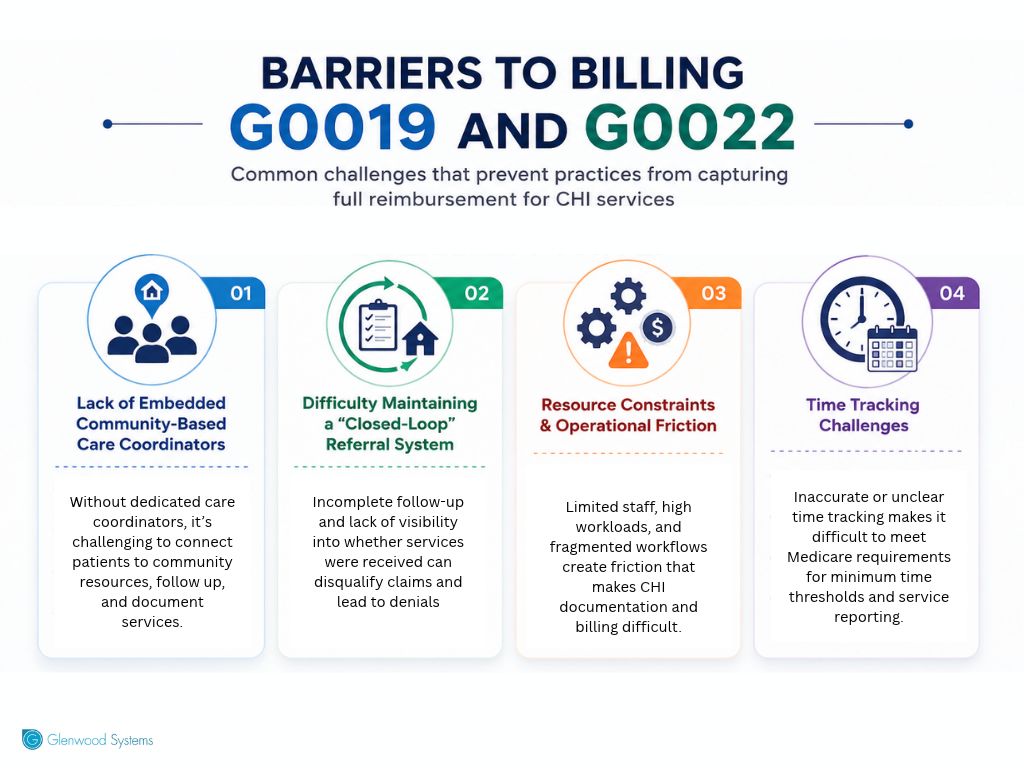
Barriers to Billing G0019 and G0022
Community Health Integration (CHI) services offer a valuable opportunity for Medicare reimbursement. However, many practices struggle to implement and bill for these services effectively due to several operational and workflow challenges, as follows:
Lack of Embedded Community-Based Care Coordinators
Many practices lack dedicated Community Health Workers (CHWs) or care coordinators integrated into their clinical workflows. As a result, care coordination responsibilities often fall to already overburdened nurses or medical assistants, leaving little time for community outreach and follow-up.
Difficulty Maintaining a “Closed-Loop” Referral System
Referring patients to community resources is only the first step. Many practices lack visibility into whether patients access those services, making it difficult to measure outcomes, coordinate follow-up, or support billing documentation.
Resource Constraints & Operational Friction
Building, managing, and maintaining complex care navigation programs internally requires significant administrative resources. Limited resources and a lack of purpose-built systems often lead to fragmented, inconsistent workflows that make it difficult to track clinical outcomes and secure appropriate reimbursement.
Time Tracking Challenges
Tracking time spent delivering CHI services is another common challenge that prevents many practices from fully capitalizing on this reimbursement opportunity. Manual methods, such as paper logs or basic chart notes, often lead to lost billable minutes, undercoding, or compliance risks. Without a centralized, EHR-integrated time-tracking system, care coordination activities become fragmented, making it difficult to capture cumulative service time and support accurate billing for HCPCS codes G0019 and G0022.
5 Steps for Successful CHI Billing
The value of CHI extends well beyond reimbursement. A study in NEJM Catalyst found that addressing the social needs of patients with both high clinical and high social risk reduced total allowed healthcare costs by $181 per member per month (PMPM). Beyond these tangible financial savings, CHI services also deliver significant non-monetary value, including improved patient experience, enhanced quality of life, and reduced health disparities.
Here’s a 5-step framework to bill CHI services.
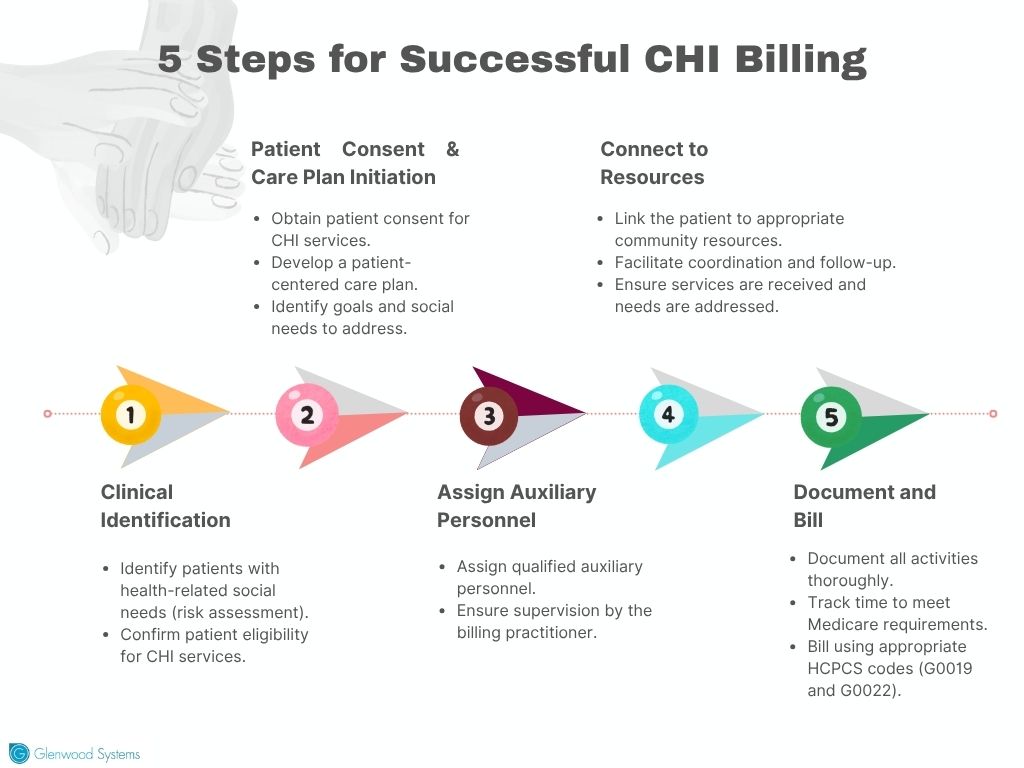
1. Clinical Identification
Identify eligible patients during an Evaluation and Management (E/M) visit or an Annual Wellness Visit (AWV). Assess them for health-related social needs (HRSNs) or social determinants of health (SDOH), including food insecurity, housing instability, transportation barriers, financial hardship, social isolation, and other upstream factors that may interfere with their diagnosis, treatment, or recovery.
2. Patient Consent & Care Plan Initiation
Before initiating CHI services, explain the program to the patient, including any applicable Medicare cost-sharing responsibilities, and obtain written or verbal consent. Document the consent in the medical record. Next, develop a person-centered care plan that outlines the patient’s identified social needs, care goals, and planned interventions. The care plan should support the practitioner’s treatment plan and include appropriate SDOH diagnosis codes.
3. Assign Auxiliary Personnel
Assign qualified clinical or trained auxiliary personnel (care coordinators) to deliver CHI services under the billing practitioner’s supervision.
4. Connect to Resources
Care coordinators engage with patients beyond the clinical setting to address unmet social needs that can undermine health outcomes. They connect patients with trusted community-based organizations and local resources to help overcome social barriers. They also facilitate referrals, coordinate with community partners, and follow up to ensure patients access these services and progress toward their care goals.
5. Document and Bill
Document all qualifying CHI activities, including the patient’s unmet social needs, interventions performed, care coordination efforts, referrals made, progress toward goals, and cumulative time spent in the calendar month. Once Medicare’s documentation and billing requirements are met, the billing practitioner submits HCPCS G0019 and G0022 for eligible CHI services provided incident to the practitioner’s professional services. Only one practitioner bills for these services for a patient in a calendar month.
Invest in Social Care. Improve Clinical Care.
Health equity begins with addressing the social barriers that shape health outcomes. Investing in social care improves clinical outcomes, strengthens patient relationships, and creates a sustainable revenue stream.
Advancing health equity is easier with the right technology partner. Glenwood Systems provides the tools to help you deliver and bill for CHI services with confidence. Our integrated solutions eliminate operational hurdles in CHI billing by streamlining documentation with GlaceScribe’s ambient AI and accurately capturing care coordination time through GlaceEMR.
Let’s connect and turn your CHI challenges into opportunities.