
GLACERCM | DENIALS MANAGEMENT
Denials Do Not Disappear. We Work Them.
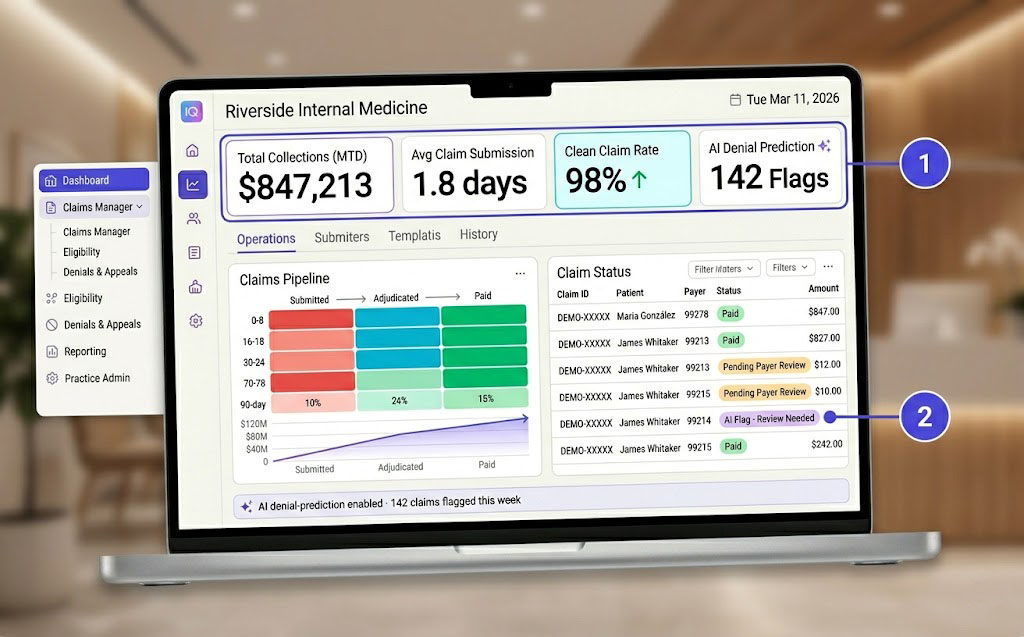
Prevention first, through scrubbing tuned to payer rules. AI flags denial risk before submission as a suggestion your biller reviews. When a denial lands anyway, a named specialist appeals it to resolution.
WHERE DENIED DOLLARS GO TO DIE
A Denial Is Money You Earned and Did Not Collect
Every denial is a claim you were contractually owed that the payer pushed back. The work to recover it is tedious, which is exactly why it gets dropped. Four patterns drain the most revenue.
Denials parked past 90 days
A denied claim that ages past the timely-filing window becomes unrecoverable. The easy claims get worked, the hard ones sit, and the aging report quietly fills with money nobody chases.
The same denial, over and over
A payer rejects a code pairing every week and nobody fixes the upstream cause, so the practice keeps re-earning the same denial instead of preventing it.
Underpayments slip through
A claim posts as paid but at less than the contracted rate. Without line-item checking against the fee schedule, the gap is absorbed and never recovered.
Write-offs by default
When working a denial costs more attention than it seems worth, it gets written off without anyone deciding to. The decision is made by neglect, not by you.
HOW WE HANDLE THEM
Prevent, Appeal, Resolve
Denials management inside GlaceRCM runs in three stages, and a human owns the outcome at every one. The AI does the heavy lifting on prediction and drafting; the biller makes the calls.
STAGE 1
Prevent at the scrubber
Every claim is checked against payer-specific rules, not generic clearinghouse edits, before it leaves. GlaceIQ scores denial risk and flags the specific defect for your biller, so most issues are fixed in under sixty seconds, before they ever become a denial.
STAGE 2
Appeal with payer fluency
When a denial lands, GlaceIQ drafts the appeal with payer-specific language for your specialist to review and file. We appeal at the level the payer’s policy requires and escalate to peer-to-peer when the clinical case supports it. The specialist signs off; the AI never files on its own.
STAGE 3
Resolve to closure
Every claim is tracked until it is paid, adjusted, or formally closed with appeals exhausted. A write-off happens only when you sign off on it, and the dashboard shows where every disputed dollar stands the whole way through.
WHAT’S INCLUDED
Worked to Resolution, Not Worked to a Threshold
Where other billers stop, we keep going. Every row below is part of the GlaceRCM service, inside the percentage of collections.
| Capability | Typical billing setup | GlaceRCM |
|---|---|---|
| Pre-submission claim scrubbing | Generic clearinghouse edits | Payer-specific rules |
| AI denial-risk prediction | Not available | Suggestions for biller review |
| Denials worked | Above a dollar threshold | Every denial |
| Appeals | First level, then dropped | To resolution, incl. peer-to-peer |
| Underpayment recovery | Often absorbed | Line-item detection |
| Write-off policy | By default at 90 days | Only with your sign-off |
Your named billing specialist knows your payer mix and your top denials by name, and the root-cause patterns they spot feed back into the scrubber so the same denial stops recurring.
A DENIAL, TRACKED TO CLOSURE
One Denial, Followed All the Way
GlaceIQ scores denial risk, the scrubber checks payer rules, and most defects are fixed before submission. If a denial still lands, the specialist works the appeal, escalates to peer-to-peer where the clinical case supports it, and follows the claim until it pays or is formally closed. Aging is a category we keep working, not one we write off.
WHAT IT ADDS UP TO
Fewer Denials Up Front, More Collected in the End
95%+
First-pass claim adjudication. Most claims pay on the first submission, so there is no denial to work in the first place.
99%+
Collection rate of payer-allowed amounts*. The dollars your contracts owe you arrive, because denials are worked to resolution.
$0
Setup and base fees. Denials management is part of the percentage of collections, so we only earn when you collect.
*Of payer-allowed amounts.
WHY PAYER FLUENCY WINS
Each Payer Denies Differently. We Know How.
Denials are not random. Each payer has its own patterns, its own preferred appeal language, and its own evidence it wants to see before it reverses a decision. A specialist who works the same payers every day learns which one needs a specific documentation packet, which one moves on a peer-to-peer call, and which code pairing one plan rejects every week. That fluency is what turns a denial from a write-off into a collected dollar, and it is the reason the appeal is drafted with payer-specific language rather than a generic template.
The pattern recognition feeds prevention. When a specialist sees the same denial recur, the root cause goes back into the scrubber as a payer-specific rule, so the practice stops re-earning the same rejection. This is why prevention and appeals are not two separate teams: the people who work the denials are the people who tune the rules that stop them, and the loop tightens over the life of the account. The denial that cost you a week of follow-up in month one is a denial the scrubber catches before submission by month six.
A named billing specialist anchors all of it. They know your payer mix, your top denials, and your codes, and they own the outcome of every disputed claim rather than passing it to a ticket queue. AI does the heavy lifting, scoring denial risk before submission and drafting the appeal, but the specialist reviews the high-risk claims, files the appeals, and decides when a peer-to-peer is worth escalating. You see the same dashboard they work from, so the aging buckets and the contract-performance view are not a monthly surprise. The dollars you earned get worked until they arrive.
QUESTIONS WE HEAR
Denials Management FAQ
Short answers below; the longer conversation happens on the demo. Tap any question to expand.
Does the AI deny or appeal claims on its own?
No. GlaceIQ scores each claim’s denial risk before submission and drafts appeal letters with payer-specific language, but every output is a suggestion a billing specialist reviews. The AI does not file an appeal, write off a claim, or change a submission on its own. A human reviews the high-risk claims the model flags, a human files the appeal the model drafts, and a write-off happens only when you sign off. The AI does the heavy lifting on prediction and drafting so the specialist can spend their time on judgment.
Do you really work every denial, or just the big ones?
Every denial, not just the claims above a dollar threshold. We appeal at the level the payer’s policy specifies and escalate to peer-to-peer when the clinical case supports it. A claim is tracked until it is paid, adjusted, or formally closed with appeals exhausted, and a write-off requires your sign-off. The dashboard shows where every disputed dollar stands, so you can see the aging buckets working down instead of filling up. Aging is a category we keep working, not one we abandon at 90 days.
How do you prevent denials before they happen?
Prevention is the first stage. Every claim is scrubbed against payer-specific rules, not generic clearinghouse edits, before it leaves the building. GlaceIQ scores denial risk and flags the specific defect for your biller, so most issues are fixed in under sixty seconds before submission. The root-cause patterns the specialist sees feed back into the scrubber, so a code pairing one payer keeps rejecting stops recurring. The cleanest denial is the one that never gets filed, which is why most claims pay on first pass.
What about underpayments, not just outright denials?
Underpayments are detected at the line item and recovered, not absorbed. A claim that posts as paid but at less than your contracted rate is checked against the fee schedule, and the gap is pursued the same way a denial is. This is part of how the 99%+ collection rate of payer-allowed amounts holds: it is not just whether a claim paid, but whether it paid what your contract entitles you to. The dashboard surfaces the contract-performance view so you can see which payers underpay and by how much.
Can you work our denials if we keep our own EMR?
Yes. GlaceRCM works your claims in your EMR or ours. We would rather run the full bundle on our platform, where the chart-to-claim integration makes the 95%+ first-pass and 99%+ collection numbers reachable, but our billing team can work your denials on your current EMR. Either way, denials management is part of the percentage of collections, with no base fees, and your billing team is reachable 7:00 AM to 8:00 PM Eastern, with 24×7 on-call coverage for urgent billing issues.
See What Glenwood Can Do for Your Practice
A 20-minute working call. We show you the platform on your specialty’s actual workflows, not a generic demo.