

Your private practice is taking shape. You’ve secured office space, finalized your clinical equipment, and hired your core staff. Now comes the most important decision that will determine whether your operations run seamlessly or grind to a halt on day one: your Healthcare IT stack.
The right digital architecture safeguards compliance, reduces provider burnout, and protects your cash flow.
To cut through the noise of legacy software vendors, we have mapped out the definitive 5-Layer Healthcare IT Framework that every new private practice owner needs to deploy before opening their doors.
The 5-Layer Healthcare IT Stack
Your practice software stack is the digital infrastructure that supports every clinical, operational, and financial workflow. Get it right, and you automate growth; get it wrong, and you create permanent bottlenecks in your daily workflows.
A medical practice’s core IT stack comprises five critical layers: the Clinical Engine, Practice Management & Operations, the Revenue Engine, the Patient Experience, and Security & Compliance.
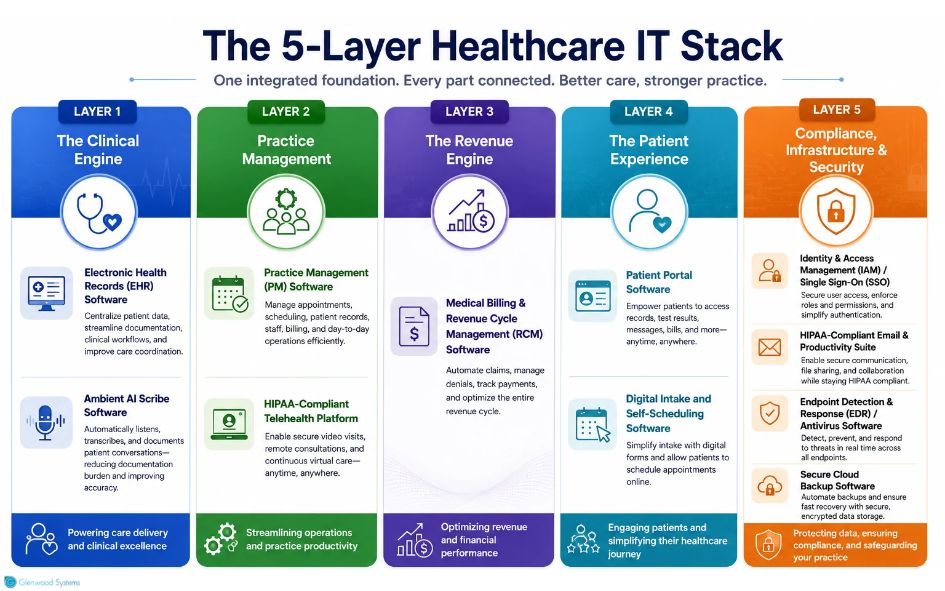
Layer 1: The Clinical Engine
The clinical engine powers your practice’s day-to-day patient care. It helps physicians document encounters, prescribe medications, coordinate care, and make informed clinical decisions. It features:
Electronic Health Records (EHR) Software
The EHR/EMR is the digital repository for all clinical documentation. It stores patient records, documents encounters, manages prescriptions, tracks medical histories, and connects with labs, imaging centers, pharmacies, and other healthcare organizations.
Advanced EHRs, such as GlaceEMR, offer a cloud-based architecture that eliminates the need for an expensive on-site server, customizable templates tailored to your specific medical specialty, and FHIR-native APIs to ensure interoperability. With information at your fingertips, you can make more informed clinical decisions, identify potential risks sooner, coordinate care more effectively, and provide timely, evidence-based treatment.
Ambient AI Scribe Software
EHRs are indispensable to modern clinical practice, yet they often increase physicians’ administrative workload. Nearly one in four physicians is dissatisfied with their EHR experience because of the documentation burden.
Ambient AI scribe software, such as GlaceScribe, is an emerging technology that addresses this bottleneck by serving as an intelligent documentation layer for your EHR. Using secure ambient voice recognition, it captures natural patient-provider conversations during visits and automatically generates highly accurate, structured SOAP notes within your EHR fields. This automation reduces the documentation burden, improves accuracy, and saves clinicians valuable time.
Layer 2: Practice Management & Operations
To support your core clinical goals, your practice needs technology that streamlines non-clinical workflows and eliminates administrative bottlenecks.
Practice Management (PM) Software
PM software manages day-to-day administrative operations, including patient scheduling, registration, provider calendar routing, and real-time operational reporting.
Modern, AI-driven practice management systems boost your team’s productivity in two distinct ways:
- Automated patient self-scheduling enables 24/7 booking based on real-time provider availability, freeing your front desk team to focus on in-person patient engagement.
- Instant insurance verification automates eligibility checks before the patient arrives, reducing manual errors and preventing costly insurance claim denials.
- Automated appointment reminders help reduce no-shows and improve schedule utilization.
HIPAA-Compliant Telehealth Platform
Virtual care is now a permanent pillar of modern medicine. Deploying a dedicated, HIPAA-compliant telehealth platform expands your geographic reach, inproves access to care, and increases flexibility for routine follow-up visits, behavioral health sessions, and chronic disease management.
Layer 3: The Revenue Engine
No matter how exceptional your clinical care is, your practice cannot survive without a robust financial technology engine. Efficient revenue cycle management software ensures accurate, compliant, and accelerated reimbursement for your services.
Revenue Cycle Management (RCM) Software
RCM software manages the financial lifecycle of patient care, converting clinical documentation into revenue. An AI-integrated RCM platform, such as GlaceRCM, operates at several critical checkpoints:
- Real-Time Eligibility Verification & Prior Authorization: Automates insurance verification and accelerates prior authorizations.
- Autonomous Medical Coding: Bridges the gap between Layer 1 and Layer 3. Modern coding software automatically translates clinical chart notes into precise medical codes, slashing coding backlogs and accelerating billing.
- Claim Scrubbing: Uses rule-based engines to cross-reference claims against updated national coding guidelines (such as NCCI edits) and correct missing modifiers or diagnostic errors before submission.
- Claim Submission: Seamlessly coordinates with medical clearinghouses to submit claims before filing deadlines.
- Predictive Denial & Appeals Management: Moves your practice from a reactive stance to a proactive one. The system tracks denial root causes, automatically generates tailored appeal letters, and coordinates swift resubmissions.
- Patient Payment Collections: Provides text-to-pay links and digital portals that streamline out-of-pocket patient collections.
- RCM Dashboards: Provide real-time visibility into practice KPIs, such as Days in Accounts Receivable (A/R), collection liquidation rates, and net revenue forecasting.
When evaluating RCM software, providers should ensure it offers all the capabilities listed above.
Layer 4: The Patient Experience
A future-ready practice must prioritize technology that enables a seamless patient experience alongside exceptional care delivery. Today, patient retention is heavily influenced by how frictionless it is to interact with your clinic.
The non-negotiable tech solutions for enhancing the patient experience include:
Patient Portal
As patients become active participants in their care journey, a secure patient portal improves transparency, engagement, and clinical trust. The portal serves as a digital vault where patients can instantly view lab results, request prescription refills, download immunization records, and message their care team via secure, encrypted channels.
Digital Intake Forms
Digital intake workflows are an operational win-win; they eliminate the burden of paper forms and drastically reduce in-office wait times. Instead of completing paperwork in the waiting room, patients can securely upload insurance cards, sign HIPAA consent forms, complete medical histories, and update demographic information before their appointment. This data flows directly into your core systems, eliminating manual data-entry bottlenecks. More than 90% of patients expect a streamlined healthcare data collection process.
Layer 5: Compliance & Security
An unshielded tech stack is an open invitation to catastrophic cyberattacks. Medical practices must implement this mandatory layer to ensure regulatory compliance and uninterrupted care.
Strengthen your systems with these essential security frameworks:
Identity & Access Management (IAM) / Single Sign-On (SSO)
IAM systems enforce Role-Based Access Control (RBAC), ensuring staff access only the specific ePHI required to perform their jobs. Integrating an SSO solution secures this process; employees log in to their authorized suite of tools through a single portal protected by mandatory Multi-Factor Authentication (MFA).
HIPAA-Compliant Email & Productivity Suite
Standard consumer email platforms lack the internal audit logs, encryption standards, and administrative controls required by law. Practices must deploy enterprise-grade suites (such as Google Workspace or Microsoft 365 Business Premium) and explicitly execute a signed Business Associate Agreement (BAA) with the provider during setup.
Endpoint Detection & Response (EDR) / Antivirus Software
Legacy, passive antivirus software is no longer sufficient to stop modern ransomware threats. EDR software continuously monitors every local device in your practice, including EHRs, laptops, and medical servers, in real time to isolate and neutralize threats the moment they hit the network. An enterprise-grade EDR is typically a strict prerequisite for qualifying for a business cyber liability insurance policy.
Secure Cloud Backup Software
The HIPAA Security Rule explicitly mandates e a functional, documented disaster recovery plan for every practice. Your backup strategy should follow the IT industry’s 3-2-1 backup rule: maintain three copies of your clinical data, stored across two different media types, with at least one copy securely isolated off-site in an immutable, highly encrypted cloud repository. This ensures that your practice can instantly restore operations in the event of hardware failure or a ransomware attack.
The All-in-One Approach: Eliminating Integration Friction
The medical practice technology checklist is a great roadmap to get you started, but piecing together an ecosystem from multiple vendors creates integration friction, data silos, duplicate data entry, workflow inefficiencies, and higher maintenance costs.
The best approach is a unified, all-in-one platform that eliminates these challenges by connecting every aspect of your practice in a single ecosystem. Glenwood Systems consolidates EHR, practice management, AI-powered documentation, revenue cycle management, patient engagement, telehealth, and security tools into one integrated platform. The result is seamless information sharing, streamlined workflows, fewer administrative bottlenecks, and a more efficient practice focused on delivering exceptional patient care.
Build and grow your medical practice stress-free. Connect with an expert today!